| 13 November 2014 |

| |
| BBC Homepage | | |
| |||
| Contact Us | | |
Surrey PeopleYou are in: Southern Counties > People > Surrey People > The Last Man Standing 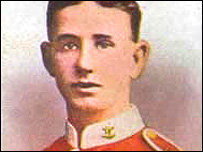 The Last Man StandingPrivate Edward Dwyer of the 1st Battalion The East Surrey Regiment, was the youngest person at that time, to be awarded the Victoria Cross, after single-handedly fending off the advancing enemy. Edward Dwyer was born in Fulham, to Irish parents, on the 25th November 1895 and brought up in Lintaine Grove. After leaving St Thomas School, he got a job as a delivery boy for a local greengrocer, before enlisting to the army, in The East Surrey Regiment, aged 16 He was your average "Tommy", following in the footsteps of hundreds of other young men of his age, who enlisted to fight in the First World War. _________________________________________________________ TOMMY AT WARThe name Tommy or Thomas Atkins has been used to describe the common soldier in the British Army, since the mid 1700's. 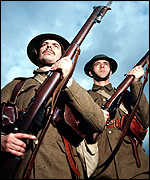 Tommy Atkins The name became standard to describe British soldiers in the First World War, and was even used by the War Office in their official publications by the 1800's. The BBC is not responsible for the content of external websites _________________________________________________________ Dwyer served at the Retreat of Mons, the first battle fought by the British Army against the Germans.  Boot theft on his record! He wasn't always the "hero" either - army records show he was disciplined for stealing another soldiers boots! But, on the 20th April 1915, Private Edward Dwyer's name entered the history books. He and his fellow soldiers were defending their position on Hill 60, a man-made strategic point, about 3 miles outside Ypres in Belgium. Edward had already left the "safety" of his trench to tend to the wounded under heavy fire during the bombardment. There were many German assaults on the hill that afternoon with the opposing trenches only 15 yards apart in some places! They were so close, in fact, that Dwyer said afterwards he could hear the enemy talking in "their lingo". All around him, his colleagues were either badly injured or dead, when the Germans began to move closer to the British trench. The last man standing, Pte Dwyer armed himself with as many grenades as he could find, climbed to the top of the trench and threw the bombs at the enemy! 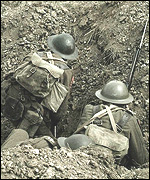 At the front One of the grenades hit the officer in charge and it may have been this that started the German retreat. They were never aware there was only one man left able to fight, in that trench. By the time more British soldiers had arrived to back him up, Edward told them "I didn't see one go back" meaning he thought he had killed all the soldiers who had attacked. He returned to the battle and a few days later, received a head injury, which meant he was sent back to Britain to recuperate. _________________________________________________________ HILL 60 - HELL ON EARTHAnother member of the East Surrey regiment described the battle, to a reporter at the The Evening News. 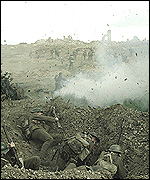 Hell on earth "The fight on Hill 60 was awful. The Germans used every kind of explosive, from small bombs to shells that shook the ground like an earthquake. This went on from four o'clock in the afternoon to about four the next morning. Some of the German shells were filled with a stinking acid, which blinded one." _________________________________________________________ THE VC'SThree Victoria Crosses - the UK's highest award for valor, were awarded for the action at Hill 60. 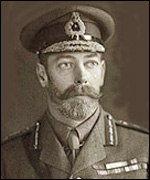 King George V Edward was awarded his Victoria Cross "for most conspicuous bravery and devotion to duty" and at the time was the youngest person to receive the medal. He was presented the honour by King George V at Buckingham Palace on 15th June 1915. Back home, he became something of a celebrity, not only in his regiment, but also with the local girls! The War Office sent "The Little Corporal" as he was nicknamed, on a recruiting drive, for the regiments, visiting schools and rallies, helping to enlist hundreds more like him. 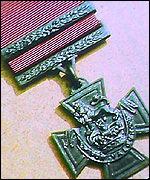 The Victoria Cross He gave rousing speeches "I promise you this, a drink and a cigar for the first ten recruits who come up here. Age is nothing, I was only 16 when I joined. Out at the front, there are men who are gray headed." At a parade in the Strand in 1915, a bystander commented "Dwyer looked quite a boy, and one of small stature too....but his hearty laughter and smiles told of his pride and joy in the demonstration." He was even featured on a set of cigarette cards in 1915, entitled The Great War - Victoria Cross Heroes. _________________________________________________________ 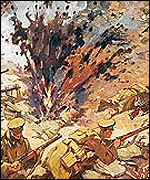 Defence of Hill 60 by Fred Roe, R.I LIFE AS A "TOMMY" IN THE TRENCHESEdward even made a recording, talking about life in the trenches and how the troops kept their spirits up. You can hear a montage of it here. Help playing audio/video _________________________________________________________ After six months of fame, Edward was yearning to get back to the battle. 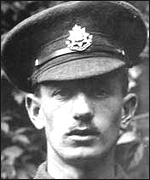 Private Edward Dwyer He persuaded the War Office to send him back to the front, where 10523 Lance Corporal Edward Dwyer VC, was killed in action at Guillemont. He died leading his platoon in the "Big Push" during the Battle of the Somme, on the 4th September 1916. He is buried at Flatiron Copse Cemetery in France, Plot III, Row J, Grave 3. His Victoria Cross is now owned by The Queen's Royal Surrey Regiment Museum, who are based at Clandon Park, Guildford. _________________________________________________________ THE DAILY MIRROR RAN THIS STORY ON 18TH SEPTEMBER 1916Priest's Story of Selflessness of Corporal Dwyer, VC"At the Church of St Thomas of Canterbury, Fulham, a high mass was celebrated yesterday for the repose of the soul of Corporal Edward Dwyer, East Surrey Regiment, the youngest VC in the Army, who was killed on September 4 leading his platoon in the 'Big Push'.
Corporal Dwyer was a native of Fulham. At the age of 18 he won his Cross 'for conspicuous bravery and devotion to duty at Hill 60, on 20 April 1915. Father Crowley delivered a short address. He expressed to Corporal Dwyer's parents, his widow and relations the heartfelt sympathy of the congregation and of the people of Fulham. Corporal Dwyer was baptised in the church and had been educated in their schools. On the day that he received his VC, Corporal Dwyer said to the boys at the school were he was educated: 'This is the most eventful day of my life, and it makes me feel I should like to do something more for my country and my religion.' 'This wish has been gratified,' added Father Crowley, 'for he has given all - he has given his life." _________________________________________________________ 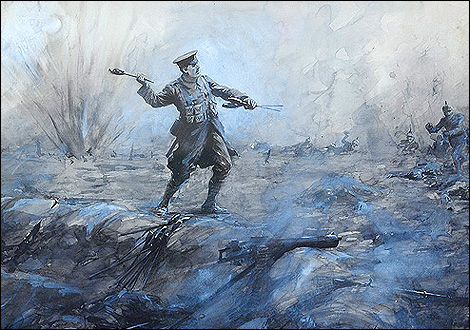 Image courtesy of The Queen's Royal Surrey Museum READ MORE ABOUT THE LAST MAN STANDING
The BBC is not responsible for the content of external websites last updated: 04/11/2008 at 15:55 Have Your SayDo you have more to add on this story about Edward Dwyer? Let us know here. Brian O'Sullivan SEE ALSOYou are in: Southern Counties > People > Surrey People > The Last Man Standing
|
| | About the BBC | Help | Terms of Use | Privacy & Cookies Policy |