 | 13 November 2014 |

| |
| BBC Homepage | | |
| |||
| Contact Us | | |
Remembrance 90You are in: Somerset > History > Remembrance 90 > Sea King Adventures 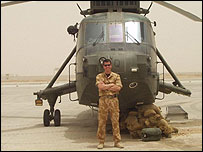 Rich joined the Royal Navy at 23 Sea King AdventuresLft Rich Sturman has recently completed a tour of duty in Afghanistan, where he flew the Sea King Mark 4. He was one of 65 personnel from RNAS Yeovilton who spent a tour of duty there from June til August in 2008. As a flight commander with 846 Squadron his responsibility involved moving personnel, fuel and equipment from his main bases in Kandahar and Camp Bastion in Helmand Province to troops on the frontline. Nearly crashing his helicopter, and flying at night in high altitudes were some of his experiences during his tour of duty. 'Relatively nice place'It's the third time Rich has served in Afghanistan, but he's also been to Iraq and Bosnia in the past. In June 2008 one of the Sea Kings Rich was flying in, almost crashed. He and his crew were were flying to assist with an RAF Shinook, which was picking up casualties involved in a road accident. "On approach to the landing site, the Sea King that I was in, as I mentioned with the dust and the light levels, unfortunately impacted the ground with the left hand under carriage. 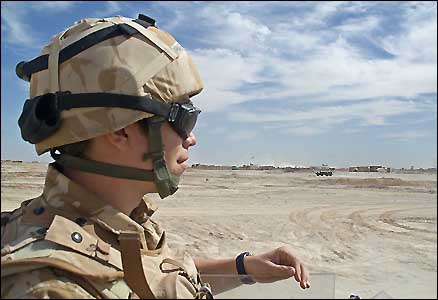 Out in the Desert "There was a small rise in the ground that we call a berm - which is like a roadside verge, not much more than a foot and a half high, that was enough side-ways motion to remove the left-hand undercarriage but further to that the aircraft rolled over to the left side as it was landing and the five blades also hit the ground." One of his bases was Camp Bastion in Helmand Province in the south of the country from where he would fly out troops and equipment. "When you hear about it a lot in the press, you start to build up an idea of what you think it's going to be like, but when you get there it's not like that at all. "Camp Bastion is a relatively nice place to be, it's when you get from there out to the forward operating bases (FOBB's) along the green zone and elsewhere in theatre that actually you start to realise that conditions are pretty poor for the troops on the ground," Richard said. Sleeping quarters also vary in size and comfort from permanent accommodation to large desert tents, which were used extensively in Iraq. Camp Bastion in Helmand Province holds about three thousand troops, and is planned on a grid system - something that can take some getting used to: "Your first couple of hours can be quite disorientating but actually once you get to know the station it's relatively easy.
"It's got quite a few decent facilities. When the guys out in the FOBB's, the ground troops, when they come back for a bit of clean up and a bit of a relaxtion, it's quite a nice place for them to return to." 'Really thin'One of the main jobs for both squadrons to prepare for this tour of duty was to get the Sea Kings ready for the demanding climate. "They have had quite a lot of upgrades, changing blades, the engines were looked at which helped them with the hotter conditions and there have been amendments since then. At the end of the day no matter which helicopter type you have when you put them in those conditions there'll always be a struggle." In summer, temperatures climb as high as 45C and there is also the added problem of working at altitude. "In Iraq it's not much different to the UK, which is at the most 1,000 feet above sea level but with Afghanistan you are somewhere between 3,000 and 4,000 feet above sea level, which, given the temperature as well, the density of the air is really thin, so not only is the aircraft working extremely hard, but physically moving around day to day on jobs becomes really hard." Night missions when the aircrew are taking off and landing when the dust is whipped up because of the helicopter blades and navigating is also difficult because of the remoteness of their location. "What we'd term as cultural lighting - which is everything you'd get from vehicles, houses, even when it gets really dark you can see quite a lot, but over there you don't have that so it makes it that much more difficult," said Rich. "It's focussing on that sort of thing than fretting about whether you get shot at." 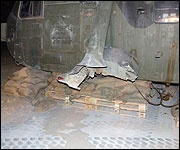 Rich flew this damaged helicopter Dangerous taskAlthough both squadrons weren't based on the frontline flying out troops and equipment was a dangerous task, where attacks from insurgents was never far from their minds. "There's obviously times where you know the threat is heightened and there's substantiated evidence of the possibility of being shot at, but actually whether or not that's happened - a lot of the time your mind is so focussed on the actual operation over there." And surprisingly the most difficult time is not at night, but during daylight hours, because ''there are a lot of glints from things on the ground so it's very difficult to spot that sort of thing to spot during the daytime. "If you're flying around at night and somebody fires at an aircraft actually it's quite easy to see that by comparison, because of 'tracer', the red bit behind the round as it gets fired," said Rich. "If you ask most people who've been in Afghanistan if they've been shot at, it's difficult to know whether they have been." last updated: 10/11/2008 at 14:29 SEE ALSOYou are in: Somerset > History > Remembrance 90 > Sea King Adventures    |
| | About the BBC | Help | Terms of Use | Privacy & Cookies Policy |
