 | 13 November 2014 |

| |
| BBC Homepage | | |
| |||
| Contact Us | | |
Remembrance 90You are in: Somerset > History > Remembrance 90 > Torture, starvation and heartache: the life of a POW soldier Torture, starvation and heartache: the life of a POW soldierDuring WWII, thousands of soldiers were captured in Singapore. Here three POWs recount their stories during a reunion at Somerset's Legion House. 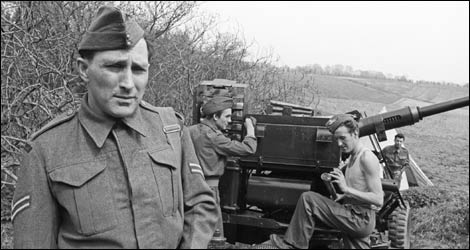 "I was blown up, I was shot, I survived the massacre, I was buried alive twice and I was up in front of the firing squad twice. Apart from that it was all right!"Fergus Anckorn, 89, joined the army at the beginning of the war and returned home seven years and three days later. 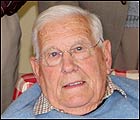 He was held captive in Singapore where he was taken, along with 10,000 other soldiers from his division (118th field regiment royal artillery), seven days before the city fell. In total about 150,000 soldiers held as prisoners in Singapore of which two third died there. "My regiment was 980 when we were taken prisoner and 250 when it finished. We didn't even get a chance to take our guns off the boats and so we were lambs to the slaughter," said Fergus. "For the first six weeks we had no food. We ate anything that moved - snails, slugs, crickets, snakes, cats, mice, dogs, grass, leaves - anything at all and that's how we kept going."
Help playing audio/video Firing lineTheir captors, the Japanese, were complicit in the prisoners' torture, as Fergus recalls. "One day the Japanese decided to shoot five of us. Just for fun; there was no real reason for it. And they took five of us out and I was one of them and they took us into the jungle, stood us against some trees and got a machine gun out and put it on a tripod and aimed it at us. "We didn't have blindfolds or anything. And we waited for the bullets for ten minutes. You would've heard my knees knocking from here I tell you. "We were talking to each other; you know 'why don't they just get on with it, get it over with, when are the bullets coming' and then they decided against it for some reason or the other, thought better of it. They put the gun away, they took us back to the camp and when we got there we found the war had been over for three days. So now you know why I'm lucky." Despite being away from home for years, Fergus was not allowed home for some three months as he "looked too horrible" and needed fattening up. After three months of eating, he was allowed home, although he still only weighed six stone. "We all came through it - it's amazing what the human frame can put up with and get away with." 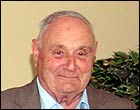 'We saw them all go down'Eighty seven-year-old Earnest Boswell joined the Royal Artillary in Blackpool at the start of the war. He was sent to Timor where he was captured. He stayed there for several months before being shipped off to Japan where he had to work all hours of the day making aerodromes. It was here that he witnessed the mushroom cloud from the American-dropped nuclear bomb on Hiroshima. "[I was] very lucky to get out. Although the war ended in August, we all only gave ourselves until Christmas to survive because we were all so thin, about six stone and then the bomb came along and that changed everything. "The conditions were terrible, we had very little to eat. In Japan it was very bad as they didn't have anything there themselves." Earnest and his fellow prisoners slept in old huts which you could look right through. In the winter, they had to walk bare foot as they didn't have any shoes which fitted them. 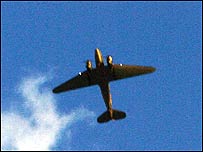 Earnest was taken away on a Dakota plane "The ice was crystallised, so when we stood up we had to crush it with our bare feet as we walked along. We just managed to get through." Although the camaraderie was good between the soldiers, the Japanese officers didn't treat them well as they used to hit them around the prisoners' heads with their riffles. "There was no rights or wrongs for them, they just did what they liked," said Earnest. When the war ended, Earnest was taken out of the county by the Americans on a Dakota aircraft. The prisoners had to choose three people from each hut to go on the plane back and Earnest was one of the lucky ones. "When we took off, we were lucky because our plane was opening and shutting (the doors to where the bombs were kept) and the plane in front didn't and the ones who got in there, they laid on the bomb bay doors and when they went over the Pacific, the bomb bay doors opened and tipped them all into the sea. We saw them all go down. All go down into the sea."
Help playing audio/video 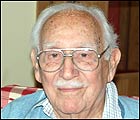 Charles Peall 'We're here to help you'Charles Peall, 91, joined the army in 1940. Although trained as a motor engineer, Charles never had the opportunity to work on a motor engine throughout his time in the British Army. After being stationed in Norway, Charles was on his way to Basra when he was captured and taken to Singapore where he had to endure marching 15 miles at a temperature of over 100C. Throughout his time held as a prisoner, Charles was tasked with many arduous jobs including building a shrine and a railway. "Life was interesting to save the least. I was fortunate to have the same people in charge of me the whole time. They were Koreans, not Japanese. All Koreans could either go into the Japanese army or become guards of prisoners of war. They had no rank whatsoever and of course they passed everything onto us," said Charles. The officers treated them with disdain. In one instance, when Charles was taking a sergeant along a mud-covered track, when it sloped away while he was taking a corner. As the ground was a foot thick of mud, the Japanese officer was not best pleased when he had to get out as he was dressed in beautifully clean clothes which got filthy. Charles' punishment was not only to be beaten, but they left him in the jungle to fend for himself for two days and two nights without any food or water. One small way the prisoners tried to get their own back was by collecting creepy crawlies and placing them under the floorboards of the officers quarters.
Help playing audio/video The prisoners had no contact with outsiders and were not allowed to mix with the Thai people however one day a well dressed Thai came over to him and said in perfect English: here's a banana, but don't eat it. So he looked at the banana and after discussing it with his comrades in the camp, they opened it up and found a piece of bamboo inside with a note saying: "We know what these b*****ds are up to and we're here to help you". It was signed by the Red Ants: The American Red Cross. 'The war is over. You go home'Charles remembers the exact moment when he found out the war was over. "We had no radio on in the camp so we had to rely on the Thai people who were not allowed to come anywhere near us at all to give us signs that there was something different. "When we were outside the camp, they held up two fingers so we knew something was on. At four in the afternoon the Japanese commander came out with a box - he had to come out in his box as he could never look up to a POW, he had to look down, and he said six words in English: 'The war is over. You go home'. "The strongest men were crying their eyes out, and hugging each other; it's over." last updated: 05/11/2008 at 04:24 SEE ALSOYou are in: Somerset > History > Remembrance 90 > Torture, starvation and heartache: the life of a POW soldier    |
| | About the BBC | Help | Terms of Use | Privacy & Cookies Policy |
