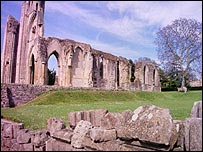
The Isle of Avalon around Glastonbury is dominated by the Tor. The remains of a pilgrims' chapel, dedicated to St Michael the archangel, who defeats the powers of darkness, perches on top of the Tor, appearing dramatic as you approach. Avalon conjures up scenes of King Arthur and the Knights of the Round Table, plus many myths and legends in an area famous nowadays for the Glastonbury Festival. However, Glastonbury boasts the remains of a formidable Benedictine Abbey church in its midst. Caring for the Abbey Said by H V Morton to be the "once mighty Abbey, the elder brother of Westminster and the birthplace of Christianity in England", Henry VIII has much to answer for, with his destruction of such places at the dissolution of the monasteries. 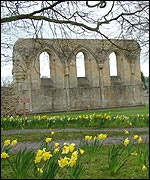 | | The Abbey is set in peaceful acres of parkland |
Set in 36 beautifully peaceful acres of parkland, in the centre of the gentle market town, the Abbey has been owned by the Church of England since 1907, when it was purchased by public subscription. The church now cares for the Abbey with affection. In his travel book In Search of England, H V Morton wrote: "St Mary's Chapel, the site of the first church built by British Christians." He questioned why the owners had not restored the chapel. I asked about this of the deputy custodian Francis Thyer, who told me that the original Trust deed stated that the Abbey should be kept more or less as it was taken over, and kept as a place of peace and quiet thereafter. There have been suggestions over the years that it be restored, but even English Heritage would find it difficult to support such a move, let alone there being enough finance to achieve it. What to see Rising sheer from the grass is the great arch of the central tower of the Abbey. Seen with the sun lighting up its warm stone, and the back cloth of a blue sky, it is indeed a beautiful spectacle. What to see? There is the Abbot's Kitchen, remarkably well preserved, square at the bottom, with a fire and enormous chimney across each corner, rising to a central octagonal lantern through which the smoke and smells from the peat fires escaped. 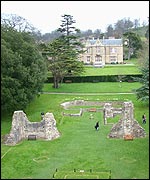 | | The church now cares for the Abbey |
Then the Glastonbury Thorn. Legend has it that Joseph of Arimathea came to Glastonbury and planted his walking staff in the ground, from which sprang the Glastonbury Thorn. Joseph was said to have brought the chalice of the Last Supper, and the Chalice Well at the Abbey became a place of pilgrimage, famous throughout the land. Pilgrimage In my younger days, I used to travel with the parish of St Gregory's in Cheltenham to Glastonbury for the annual Clifton diocesan pilgrimage. Fourteen massive wooden crosses were assembled at the top of the Tor and borne on the shoulders of Knights of St Columba, and others, down to the field at the rear of Our Lady St Mary of Glastonbury Catholic Church in Magdalene Street. Then Mass was held, with the crosses being kept erect during Mass. Nowadays, in true ecumenical spirit, the Church of England allow Mass to be offered in the ruins of the Abbey Church. The diocesan pilgrimage now includes the statue of Our Lady of Glastonbury, designed by Philip Lindsay Clark, being borne from the Tor in procession down to the Abbey for Mass. The Diocesan Pilgrimage is normally held on the second Sunday in July. |