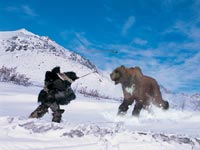
IntroductionThe first humans left their African homeland 100,000 years ago and began an epic journey that was to end with mankind dominating the globe. On their voyages they encountered monster-like creatures and perilous lands that would test their powers of survival to the very limit. In this series we journey with them into an unknown world. Where man was both hunter and hunted. Programme 1: The Eternal FrontierNorth America - 13,000 years agoWhile the world was still in the grip of the last ice age, humans first crossed Siberia and entered the New World. They encountered creatures familiar to them from their travels, such as the woolly mammoth and the steppe bison, but also a whole host of new marvels. The Americas was the only continent where humans ever came face to face with sabre-toothed cats, giant ground sloths or the massive short-faced bears. As the climate warmed and the ice melted, all these megafaunal marvels vanished. What or who was responsible for their demise? Find out how the short-faced bear and the mastodon were brought to life on the Wild New World website. View preview of The Eternal Frontier
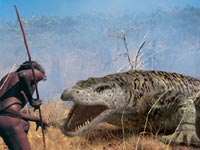
(Requires free software: RealOne Player) Programme 2: The BurningAustralia - 67,000 years agoHumans travelled out of Africa and reached South-east Asia perhaps as early as 90,000 years ago. Then around 65,000-68,000 years ago a momentous event happened - someone discovered Australia. The ancestors of the Aborigines made a daring sea voyage and set foot on a new and lonely land. Ancient Australia was a land of drought and fire, with a unique fauna dominated by marsupials, reptiles and giant flightless birds. The first Australians shared their home with the two-tonne Diprotodon, the giant short-faced kangaroo and the platypus. Emus and cassowaries were dwarfed by the 'demon duck' Genyornis. Predators like the marsupial lion and the giant ripper lizard, Megalania, stalked the land. View preview of The Burning
(Requires free software: RealOne Player) Programme 3: The End of EdenNew Zealand - 850 years agoNew Zealand was the last major land mass to be discovered and colonised by humans. A mere 850 years ago, Polynesian seafarers arrived in a land with no terrestrial mammals. New Zealand was a land of birds, and its avian rulers were giants: huge herbivorous moas were hunted by Haast's eagle - the largest eagle the world has ever seen. But within the space of only 100-400 years, the eagle, all the moas and over 20 other species of birds were gone. Had mankind become the monster? View preview of The End of Eden
(Requires free software: RealOne Player)
|