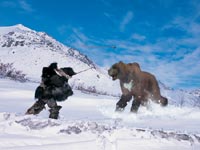
Man the hunterThe 'overkill' hypothesis holds that megafauna (animals with an adult weight greater than 44kg) vanished only a few centuries after the arrival of man. The key arguments of the overkill hypothesis are: - only the larger animals disappeared
- there is archaeological evidence of human hunting
- animals had survived previous times of climate change
Large animals disappearThere have been many mass extinctions throughout geological history, the most well-known being the disappearance of the dinosaurs at the end of the Cretaceous Period. In analysing these events, scientists find that small, medium and large species all become extinct. Megafauna always suffer the heaviest loss. In contrast, extinctions at the end of the Pleistocene around 10,000 years ago seem to target large animals, with the small to medium ones escaping relatively lightly. Scientists who support the overkill hypothesis believe that this evidence points to humans as the culprits. The impact of human hunters on populations of large, slow-maturing, slow-breeding animals, such as mammoths and diprotodons, was bound to be far greater than any effect they might have had on small, rapidly breeding prey such as hares or squirrels. Therefore, the overkill theory seems to explain why only the megafauna died out. Hunting in Europe and AsiaAlthough ice age Europeans preferred to hunt the smaller types of megafauna - reindeer, red deer, bison and horses - they may also have hunted mammoths. Mammoth bones were an important resource in Eastern Europe and the Ukraine where people used them to construct huts and windbreaks. Most of the bones recovered from digs have no cut marks from stone tools, so they were probably gathered from 'graveyards' found at regular mammoth gathering sites, such as waterholes or salt licks. However, some of the bones do bear butchery marks, which some interpret as evidence of ice age mammoth hunting. Next - Man the hunter in the Americas
|