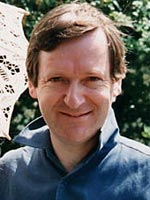
| Adrian Lister- Professor of Palaeobiology, University College, London
- Professor Adrian Lister gives his view on the European extinction of megafauna.
For the past three years, Adrian Lister and Tony Stuart have been undertaking new research to try to understand the extinctions that wiped out dozens of large mammal species toward the end of the last ice age. This is a topic where there has been no shortage of theories and a lot of argument, but not nearly enough hard evidence to decide which theory is correct. Europe "We chose several well-known extinct species for study, including the woolly mammoth, woolly rhinoceros, and giant deer (Irish elk). In every country where these species lived, covering large areas of Europe and Asia, we searched for the latest known remains and determined their age by radiocarbon dating. In this way we traced the shrinkage of the species' range over thousands of years leading up to their extinction. "We found that the mammoth, for example, had disappeared from much of its range by 12,000 years ago, following a natural change of vegetation from the rich grassy habitat which provided the animals' chief food, to various forms of forest and tundra to which they were poorly adapted. This suggests that the first stage in their extinction was caused mainly by vegetational changes, in turn driven by climate change. "After that, our data suggests that the mammoth's range splintered into several small populations hundreds or thousands of kilometres apart, a situation which - as is well known from endangered species today - leaves the animals very vulnerable to further stress. It is possible that they then succumbed to a mixture of further warming, and hunting by prehistoric humans, the last populations petering out one by one between about 11,000 and 4,000 years ago. "Although humans may have played a role, this is a far cry from theories that suggest that hunting wiped out millions of animals across the entire original range of the species." . Next - What the experts say - Americas
| |