Back in the 1500s, Shrewsbury made its fortune on the wool trade. Wool merchants based in the town bought Welsh cloth at Oswestry Market, then took it back to their home town to be made into clothes. 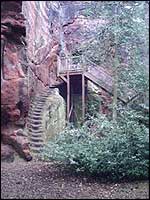 | Kynaston's cave in Nesscliffe. According to the legend, the highwayman - and his horse - climbed up the stone-cut steps on the left to his lair. These days a wooden staircase makes the journey less hair-raising. |
Trading these clothes in London reigned in fat profits for Shrewsbury merchants, who built themselves fine timber houses. However, it wasn't all plain sailing for these merchants. Trading meant carrying large quantities of gold and silver to Oswestry. And Nesscliffe, with its high wooded hill, was just the place for the enterprising highwayman to relieve them of it. Highwayman would wait on Nesscliffe Hill, where they could see the approaching merchant's horses, before attacking. And the pub just east of the village, the Wolf's Head, was well-known as a meeting place for all sorts of criminals. Of all the highwaymen who terrorised the road between Shrewsbury and Oswestry, Sir Humphrey Kynaston was the most feared. 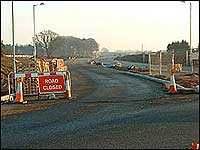 | The Wolf's Head is gone these days but it's remembered in the name of the roundabout at the western end of the Nesscliffe bypass. |
Sir Humphrey was a bit of a tearaway at the best of times, but things went seriously off the rails when he inherited the family home of Myddle Castle. Unfortunately for Sir Humphrey, he couldn't afford to keep the castle as well as continue with his lifestyle. Outlawed for his debts, Sir Humphrey abandoned the castle and went on the run, setting up home in the sandstone caves above Nesscliffe. It was here, according to legend, that the outlaw lived with his horse, evading all attempts at capture. In the true mould of the robber-hero, Sir Humphrey is said to have stolen from the rich in order to give to the poor who lived nearby. 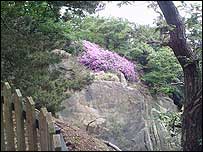 | Above the highwayman's lair, Nesscliffe Hill is a magical place |
In return they protected him, providing him and his horse with food. Some stories even claim Sir Humphrey's horse was the devil himself. One account claims the horse was called Beelzebub! Kynaston and his horse made an unbeatable team, and many of the stories about this dynamic duo credited them with superhuman abilities. For example, the local lawmen once set a trap for the highwayman at Montford Bridge. The structure crossing the Severn in the village these days was built by Thomas Telford in the early 1800s, but in the time of Sir Humphrey, it was made of stone and wood. The sheriff and his men removed the planks from the bridge, leaving a gaping hole, and waited for their man. On arriving at the bridge and sensing a trap, Sir Humphrey spurred his horse on, jumped the gaping hole and escaped. On another occasion, Sir Humphrey is said to have jumped his horse from the top of Nesscliffe and landed at Ellesmere - nine miles away! 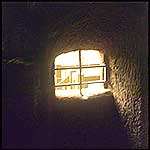 | Kynaston's cave is pretty well fitted out with windows, a fireplace and chimney and even a trough for his horse. |
There's even a section of the Severn, 40 feet wide, called Kynaston's leap, where the highwayman is said to have jumped the river.
One day, so the legend goes, he found a man sitting in his seat at the Nesscliffe pub, so he calmly went over to him, drew his pistol and shot the man dead before escaping up a chimney. After a lifetime of evading the law, Sir Humphrey died of illness in his cave. The cave can still be visited today. Steps cut into the red sandstone lead up to a cave split into two, although erosion has meant that a wooden staircase is now used to get into the cave. Intriguingly the initials H K and the date 1564 are carved into the rocks. And if you visit the Old Three Pigeons pub in Nesscliffe, Sir Humphrey's seat, reputedly taken from the cave, is part of the fireplace! |