| 24 September 2014 |

| |
| BBC Homepage | | |
| |||
| Contact Us | | |
DialectYou are in: Shropshire > People > Dialect > Is there such a thing as a Shropshire dialect? 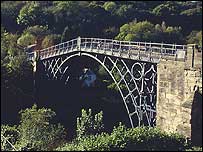 The iron bridge Is there such a thing as a Shropshire dialect?In her 1897 book, Georgina Jackson concluded that there is no single Shropshire dialect. According to modern observers, the same is true today. Find out how Shropshire's dialects have been influenced. You might believe that Shropshire would be far more narrow in its range of accents and dialects than the more multi-cultural cities. However, the county's geographical position does much to combat this.
Welsh influenceSitting on the Welsh border, it's inevitable that elements of the Welsh language have entered popular Shropshire usage, particularly in the west of the county - both north around Oswestry and further south around Ludlow, a stretch of land which used to be known as the Welsh Marches. There are many Shropshire place names which are Welsh in origin or spelling. The Welsh influence is also heard in accents - again particularly around the Oswestry area. Nor is this influence simply a historical one. Even today you're often almost as likely to hear Welsh spoken in Oswestry town centre as English. East ShropshireDr Clive Upton, a linguistics specialist with the School of English at the University of Leeds is quick to point out this cross-border influence. Although we place geographical and administrative borders around our villages, towns and counties, language does not recognise such boundaries. 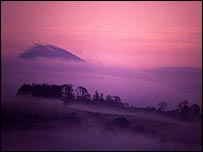 The Wrekin has given rise to a few local sayings. And what is true of the West is also true to Shropshire's east. The Black Country, and the industrial West Midlands continues to exert an influence on accents and popular phrases to this day. Many phrases such as "Pithering about" (meaning "messing around"/"wasting time")... "Ow bist?" (meaning "how are you?") and "Sweating Cobs" ("sweating profusely") would be understood by our immediate neighbours. Most famously perhaps, East Shropshire has given birth to a popular phrase also used in Wolverhampton and the West Midlands: "All around the Wrekin" meaning to take an indirect route to a location or to more commonly avoid getting to the point during a conversation. Agricultural and industrial revolutionsInevitably the agricultural and industrial revolutions (which particularly affected Shropshire) also brought a huge influence to bear on the spread of language from the 16th and 18th Centuries respectively. The increased mobility during these times, accelerated by the introduction of canal networks and then the railways, only reinforced the spread of certain words and phrases. In this way, factories would become something of a linguistic melting pot as people headed towards this new source of work. But while many words travel miles and are often understood across large areas of the country, others can be very isolated indeed. South ShropshireAlf Jenkins from South Shropshire sees language and dialect, in part, as a social history. Words and phrases travelled with people across the UK. Wherever they settled down, they would introduce the words and phrases that they were brought up then adding new words to the local lexicon. 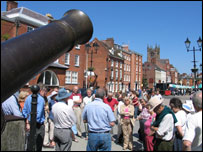 Ludlow square South Shropshire the people of Clee Hill, originally a small, isolated mining community would adapt words for their own use. There, the language originating from the cider making and grain industries had little relevance. However, the term "Fut Racks" (tracks created by sheep) meant something. Therefore in Clee Hill the word "Ganzie" (commonly meaning jumper/pullover) would be used to refer to a waistcoat. If you didn't come from the area, you were probably a "Ewkin" (a valley dweller)... as opposed to an "Upper Wummer" (hill dweller). Interestingly the language of Clee Hill was often not even understood in nearby Ludlow (only around five miles away). In many ways, accents are more difficult to measure than the words we use. While it's easy to differentiate between Cockney, Birmingham, Liverpool and Yorkshire accents, others can be a little trickier. Differing local accentsBritish accents contain many subtleties, most of which are brutally clear to those from a specific area. They say it's easy to spot the differences between those from Ludlow and those from Newport. Despite the geography, both are market towns of comparable size and both developed as the focal point for their respective farming communities. While Ludlow locals tend to elongate ("aahrr") and even swap their vowels "foot" becomes "fut" and "feet" becomes "fit"; the towns near Telford take on a West Midlands influence. But if you live in the Telford area, do you think you could tell the difference in accents between people from Wellington and those from Oakengates? Similarly, if you come from South Shropshire, could you distinguish between a Ludlow and a Church Stretton accent? The same question could be asked of Wem and Whitchurch; Oswestry and Ellesmere; Bridgnorth and Highley. However, to confuse matters, we not only have the east-west, but also north-south influences affecting us. The north-south divide is well known in many terms (political, economic, and even general attitude), but it also affects the words and phrases we use and the way we say them. Therefore, in the centre of the UK, Shropshire has influences pulling it in many different directions. If there is a Shropshire accent, it's a tendency to lose consonants and elongate/swap vowels: "Inna" for isn't, "canna" for can't, "dunna" for don't, "munna" for mustn't and "wanna" for want. Other words are less easy to identify, "surree" (or sirree) is a word used across Shropshire to express surprise or simply to draw particular attention to something. So then, historically, certain words spread as people travelled and were then modified (or misunderstood) to suit the local purpose, local industries and the local temperament. In Oakengates, "Jockeys" was a friendly greeting ("Ow bist thee owd jockey"), and a term for young lads - a reference to the town's famous son, the jockey Sir Gordon Richards. Local and regional variationIn this way local and regional variations were developed almost exclusively among the working class. Esoteric words were created/modified, driven by the need to name items and activities unique to certain industries in still relatively isolated communities. Suitably the mining and farming industries (both well represented at one time in Shropshire) played their part. Many areas across the area would recognise "Mawkin" as meaning "scarecrow"... While "Mawskin" was occasionally used to refer to the stomach of a cow. Both miners and farmworkers (across Shropshire, Herefordshire and Worcestershire) would find a use for "yarks" - bands worn around the knees to keep trousers raised out of the mud, ever-present both down-pit and on fields. Variations and modifications were propagated not only by need, but by ease and familiarity. Local dialect was born within the class bracket, not across the boundary. So the comfortable language and accents that we are familiar with today originated not when the Lord of the manor talked to his workers but when friends and communities had a good "chin wag" or "cantin" (both meaning gossip) in either a social situation such as a pub or in the street, or very close working conditions. Slang has always developed in this way (and continues to do so today). Learn to Spake Salop with Richard BeaumondHelp playing audio/video last updated: 25/04/2008 at 10:42 You are in: Shropshire > People > Dialect > Is there such a thing as a Shropshire dialect? |
| | About the BBC | Help | Terms of Use | Privacy & Cookies Policy |