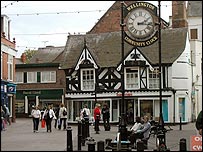
The landscape around Wellington is dominated by The Wrekin, one of the most distinctive landmarks in the county. The hill also greets travellers arriving in Shropshire on the M54 and is the first real sign that you have entered the county. Historians believe that Wellington was originally called Weoleahington, meaning 'The settlement by the temple'. What happened to the temple, we don't know, although some speculate that it might have been on the site now occupied by All Saints' Church. After the demise of Viroconium (now Wroxeter) as the capital of the area, Saxons established a new capital at Wrockwardine and a temple for the area at Wellington. 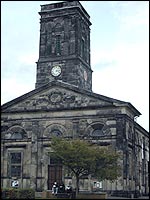 | | All Saints church |
Although it may be the oldest Wellington in the world, it shares its name with at least 24 others! Wellingtons can be found in Australia, America, South Africa, Canada, New Zealand... and Somerset! Traditionally, Wellington has had a strong manufacturing heritage which, like so many places around the country, has fallen into decline. However, the market upon which much of the wealth of Wellington was built, remains a powerful influence on the town's life. The heart of modern Wellington is appropriately its Market Square, which also hosts a very popular farmers' market every third Saturday in the Month. The nearby retail market is one of the oldest and largest in the country. Regular markets are held every Tuesday, Thursday, Friday and Saturday. 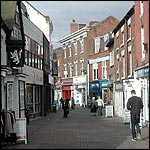 | | Crown Street |
One of the Town's most dominant buildings is All Saints Church, designed by George Steuart in 1790, to replace the previous medieval church. Steuart also built the nearby Attingham Park. One of the highlights in the Wellington calendar is the nationally renowned Literary Festival, which takes place through October and attracts some of the UK's top authors including Kate Adie, Colin Dexter and many more. Wellington's famous sons include the poet Phillip Larkin, who was, for a while, a librarian in the town (The town now boasts a street named Larkin Way). The 18th Century physician, Doctor William Withering (Born in Wellington in 1741) was not only a vocal member of the Society for the Abolition of the Slave Trade, but was one of the first people to investigate the properties of digitalis, used in the treatment of heart disease. Wellington also has substantial sporting representation. The current Unibond League team AFC Telford was until 1969, known as Wellington Town. Wellington Town had a history dating back to 1872. The New Bucks Head stadium is one of the most spectacular in non league football. 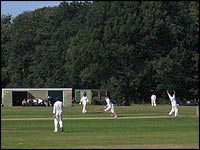 | | Wellington cricket club |
Wellington Cricket Club has also proved itself a force to be reckoned with. After gaining promotion from the Shropshire league, Wellington CC progressed through the Birmingham league until they won the premier division title in their first season in the division. In doing so, they became the first Shropshire side to claim the title. Despite the ongoing development of Telford, Wellington retains its own distinct identity and the town centre remains a vibrant location. |