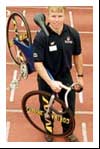
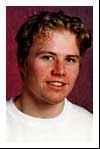
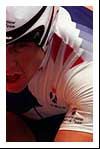
Previous Page Craig MacLean wins World Championship gold 2002World champion track cyclist Craig MacLean has never received either the recognition or financial gains as his compatriot Chris Hoy, perhaps because Hoy succeeded individually whereas MacLean’s best results have came as part of a team. Or maybe he is a victim of the remarkably health state of British track cycling, which has produced some of the best riders in the world. In another era MacLean’s consistently good performances on the world stage would receive the widespread appreciation it merits.The Olympic Sprint team, of which he is a crucial member, has won medals at every world championships from 1999 until the present, including gold in the 2002 worlds at Copenhagen. In 2000 the team won silver at the Sydney Olympics. He is now considered the best lead-out man in the world and can power his bike at speeds of over 40mph, over a distance of 250m from a standing start. Although MacLean didn’t take up track cycling until the relatively late age of 24, he has always been a cyclist: "I’ve always been passionate about cycling. We always had bikes about the house and my dad was a cyclist also." He started racing BMX bikes in the early 1980s in his home town of Grantown on Spey, in the highlands of Scotland but from the age of 15 he moved away from competitive sport in what he describes as his rebellion stage. He moved to Edinburgh to study musical instrument technology and at this stage was only riding as transport and to keep fit. His interest in the competitive aspect of the sport slowly grew and he began to race in different cycling disciplines. He would go down to the cycling track at Meadowbank Stadium initially to watch the track leagues and then he joined a local club in Edinburgh. It was on leaving college in 1995 that began specialising on the track. He said: "I didn’t have a clear cut path toward being a track cyclist. But when I finished studying I thought I might as well give it a go." Although he came to the fore in the Team Sprint, his initial focus was in the individual events and admits that the Team Sprint didn’t feature highly in the ambitions of the British team before 1999, when they began their remarkable run of success in the world championships He explains: "In the early days we weren’t strong enough as a team to win medals but coming to the Olympics in 2000 we trained specifically for the team event. This made a difference to our results as other countries concentrated on the individual events. By winning the silver, we were punching above our weights." But after the Sydney Games MacLean became disenchanted with his sport, which strangely, culminated in his changing position in the team to becoming lead out man. MacLean found his niche and improved the performances of the team."Post Olympics after winning the medal, I thought I’d made it in terms of financial rewards but we made nothing from the Olympics. "In 2001 I became disillusioned and wanted to spend the least amount of time on the bike. Chris Hoy suggested I change from second man to first as he wanted to concentrate on the individual events. I agreed as it’s easier to train as man one because you just need to be strong, which means less time on the bike in training. "It sounded like the easiest option at the time, but of course if you want to do something properly it’s never the easy option. But the change meant that everything fell into place for the team." At the following year’s world championships in Copenhagen , MacLean showed his affinity for the new role by setting the fastest first lap times ever recorded in the event whilst leading the team to gold. From a standing start, he propelled himself around the 250m track in under 18 seconds. His best time was 17.60 seconds, an average speed of over 31mph. He would then peel off, leaving Jamie Staff and Chris Hoy to finish the race, both still relatively fresh having each expended something like 40 percent less energy than Craig during that first lap, due to slipstreaming.He went into 2004 hoping to better his silver medal at the Olympics but a viral infection destroyed his year’s training and made him forget plans of retiring at the end of that year. He made it to Athens and rode both the Kilo and the Team Sprint but performed well below his best and finished seventh in the individual event. He found the whole experience frustrating. He recalled: "It was the type of thing that you felt you were recovering and you would have a couple of good weeks and then suddenly you felt as if you hadn’t trained at all. "I didn’t have bad form when I entered the games but I wasn’t at my best and finished seventh in my event which isn’t disaster by any means but it was pretty poor for me.” And so MacLean is now looking forward to the Team Sprint at the 2008 games. "I still feel I’ve got unfinished business at the Olympics and I want to leave the sport with some good memories rather than thinking what might have been. "The Olympics is the pinnacle for pretty much every sport as its so high profile. It’s nice to be World Champion and it is more competitive because the qualifiers eliminate a lot of riders but the Olympics is only once every four years so you don’t get to do it very often." However MacLean chances of winning a medal have been halved through no fault of his own after the Olympic committee decided to replace the Kilo with BMX racing. He said: "I just don’t understand the logic of it. Someone who is obviously not a fan of track racing has taken the decision as the sport has had to lose two events for BMX." Written by: Gordon Cairns |