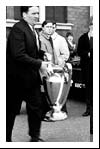
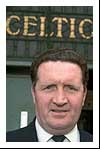
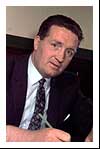
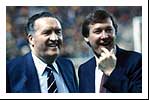
Previous Page Jock Stein dies 1985On 10 September 1985 at Ninian Park in Wales, Rangers winger Davie Cooper stepped up to take the most important penalty kick of his life in the 81st minute of a World Cup qualifying encounter between Scotland and Wales.The Tartan Army's place at the finals in Mexico '86 depended almost entirely on Cooper striking the target, as the Scots were trailing the Welsh 1-0, thanks to an early Mark Hughes goal in the 13th minute, and only a draw or a win against their celtic cousins would guarantee Scotland one of the two qualifying places from Group VII. As the 80th minute approached, Scotland's Stephen Nicol had set up a telling cross which was nodded on by Graeme Sharp and found David Speedie in the box - the little striker then sent the ball forward, and Welsh defender David Phillips was adjudged to have handled in the penalty area. Referee Johannes Keizer of Holland didn't hesitate in pointing to the spot, and the entire Scottish nation watched with nervous anticipation as Cooper stepped up and converted with cool confidence. The Scotland coach, Jock Stein, watched from the dugout as the drama unfolded; looking pale and concerned, he leaned forward to catch a glimpse of the unfolding action on the pitch, but in the moments that followed the goal celebrations, as the crowd of Scotland fans in Ninian Park erupted in celebration, Stein remonstrated with an intrusive photographer near the dugout, then collapsed on the track and died shortly afterwards on the physiotherapy table in the away dressing room. In those brief moments, probably the greatest light in Scottish football history was extinguished, and the game north of the border never truly recovered. The Big Man The only son of George and Jane Stein, John 'Jock' Stein was born in the small Lanarkshire mining village of Burnbank on 5 October 1922, during the global Depression that followed World War I. Following a brief career as a labourer in a carpet factory, and later as a coal miner, he signed for Burnbank Athletic in 1940. However, his father had harboured ambitions of him playing for Blantyre Victoria, and possibly progress onwards to the professional club the family supported, Glasgow Rangers. He subsequently denied young John the opportunity to play for Athletic - so the red, white and blue strips of the Vics beckoned. On 14 November 1942, aged just 20, Jock took to the field as a professional player for Coatbridge club Albion Rovers occupying the traditional centre half position, but making very little impression on a 4-4 home draw against Glasgow Celtic at Cliftonhill.And so began one of the most inspiring careers in world football history. The Wee Rovers would remain Stein's club for the next eight seasons, during which time he would feature in 236 appearances for the club and score nine goals, whilst still working as a miner in the Lanarkshire coal pits. He was married on 3 October 1946 to Jean Toner McAuley, and in 1950 he departed Cliftonhill and made a surprising trip across two borders to the non-league Welsh side, Llanelly Town. The transfer was acrimonious - not to mention illegal - and a series of protracted negotiations, combined with homesickness and deteriorating results for the club, saw Stein return home to Lanarkshire with the intention of giving up football entirely in favour of a life down the pits. Had it not been for the vision of the legendary Celtic scout, Jimmy Gribben, the Glasgow club may never have known the heights of success they would eventually reach under Stein, both as a player, and later as manager. For it was Gribben who passed Stein's name along to Celtic's chairman Robert Kelly, and an approach was quickly made to Llanelly Town, shortly before Stein made his fateful journey back home to Scotland. Celtic's fans were unconvinced when Big Jock signed for the club in December of 1951. Many considered him to be too old, and much was made of his background as a Rangers supporter. His father refused to speak to him over the matter, and many of his old acquaintances in Burnbank turned their backs on a man whom they had perceived to have 'turned coat' on them. Stein was unperturbed. Almost by accident, his career at Celtic soon expanded into the role of club captain when Sean Fallon broke his arm during the 1952-53 season. Fallon had already nominated 'Big Jock' as his vice-captain over the legendary Bertie Peacock, and the Irishman never regained the armband, but did go on to make his mark as Stein's right-hand man in their famous managerial partnership at the club in later years. In his role as the club's leader on the pitch, Stein captained Celtic to victory in the 1953 Coronation Cup, defeating the tournament favourites, Hibernian, in the final – but not before Aberdeen, Rangers, Arsenal, Manchester United, Newcastle and Tottenham Hotspur had all been eliminated from the competition. However, Stein's crowning glory in the Celtic colours as a player was the League Championship and Scottish Cup double the club earned during the season that followed. On 29 January 1957, aged 34, Stein retired as a player from Celtic Football Club, mainly due to a persistent ankle injury, having notched up 147 matches over six seasons. His final appearance for the club as a player was against Coleraine, during a close-season encounter.During this period, Stein developed his skills as a coach and was offered the job of staff coach to the Celtic youth squad, but the position held no ambition for the big man, and in 1960, he soon found himself with the paradoxical challenge of rescuing Dunfermline FC from relegation and establishing himself as manager of the Fife club. The resounding effect of Stein's move from Celtic to Dunfermline was confirmed when he guided the club to the final of Scottish Cup in 1961, defeating his former club 2-0 in a midweek replay, following a goalless draw at Hampden on Saturday 22 April. It was the first time in Dunfermline's history the club had won the trophy. Success loomed ahead of him, and it is perhaps the least-recognised of all Stein's achievements that should probably rank amongst his greatest. In the 1962-63 season, Dunfermline qualified to play in the Inter-Cities Fairs Cup, and the Pars eliminated Everton 3-1 on aggregate, conceding only one goal at Goodison Park in the first leg. But it was the monumental performance in the next round that sent shockwaves around Europe, when Dunfermline clawed back a four-goal deficit from the first leg of their encounter with Spanish giants Valencia, and notched up an incredible 6-2 scoreline at East End Park to take the match to a play-off in Lisbon. Shortly after his spell at Dunfermline, Stein was appointed manager of Hibernian, where he won the Summer Cup and expanded his talents as a manager. However, his spell at the Edinburgh club was short-lived, and just one year later, in 1965, he was approached by a crisis-struck Celtic to return to the club as their manager. Success in Glasgow with Stein at the helm was almost instant, and for the next 13 years, Celtic's dominance of Scottish football became supreme. He started by guiding the team to the Scottish Cup and defeating his former club, Dunfermline; Celtic's first major win since 1958. He went on to win the club's first ever domestic treble and set a phenomenal Scottish football record of nine successive league championship titles in a row from 1966 to 1974. In 1966, Celtic also reached the semi-finals of the European Cup Winner's Cup, where they eliminated by Liverpool on away goals. On 25 May 1967, at the Estadio Nacional in Lisbon, Portugal, Celtic faced Inter Milan in the final of the European Cup and became the first British and northern European club to win the trophy, overcoming the Italian giants 2-1 to bring the famous trophy to back to British shores for the first time ever. It was the ultimate achievement in an ongoing success story generated by Stein's presence at the club. The early success of Celtic under Willie Maley was completely overshadowed by Stein's unstoppable progress and innovation. Before him, Celtic were not recognised outside of the UK, and barely noticed outside of Scotland. In the three decades before Stein took over, Celtic had won only three league titles, and had not picked up a single piece of silverware since 1958. As many observers have commented over the years, Jock Stein was Celtic; he made the club what they are today and his legacy remains as relevant in the modern era, as it did 40 years ago. When Stein departed the club in 1978, the circumstances were less than amicable. Celtic refused to reward his services at the club with a role on the board of directors, instead, they offered him offering him the opportunity to manage Cetic's pools outlet, but Stein gracefully declined and moved on to succeed Jimmy Armfield as manager at Leeds United FC, but remained in the job for only 45 days, before resigning to take up the position as head coach of the Scotland national team. Stein had previously taken on the role as part-time national manager of Scotland in 1965, whilst still in charge at Celtic, but under his stern leadership from 1978-1985, Scotland reached the World Cup Finals in Spain '82, suffering elimination only on goal difference to the Soviet Union.On 10 September 1985 in Cardiff, Jock Stein's life ended as it he had lived it – through football. His final decision as head coach of Scotland was to substitute Aberdeen's Gordon Strachan for Davie Cooper in that ill-fated World Cup qualifying encounter with Wales. Cooper took to the field and netted the penalty-kick that sent Scotland to the World Cup in Mexico '86, an achievement which Stein would never realise. His individual record as Scotland head coach is second only to Craig Brown's; 68 games played, 30 won, 13 drawn and 25 lost. However, the football vision of a Lanarkshire miner can never be truly explained by statistical analysis alone. Stein was more than a collection of phenomenal results. By most accounts he was also a gregarious character; chatty, friendly and intelligent – with presence, unique man-management skills and a fiery temper that could silence a dressing-room full of confident young stars in an instant. Exactly how he managed to transform a team of underachievers into a feared force in European football at the first attempt defies explanation, but Scottish football stepped into the light when Stein left his mark on the game, and many of today's top managers owe something of their achievements to Stein's tactical nous. In a conversation with the former Liverpool manager Bill Shankly shortly after Celtic's historic win in Lisbon, Shankly told Stein: "Jock, you're immortal now." |