

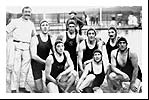
 |  |
© EMPICS | |
|
An all-round sportsman over six-foot tall, he played football and cricket for Inverness teams as well as competing in heavy and track athletics events.
Born in Inverness in 1877, he played as a back for the Inverness Amateurs team that won the Scottish Championship once and reached four other finals. He represented Scotland 17 times between 1897 and 1912.
According to swimming historian Peter Bilsborough, Scotland can take great credit for developing the modern game of water polo. Members of Bon Accord Swimming Club started to play a ball game in the water called "aquatic football" in the early 1870s. Players had to sit in the water and kick the ball with their feet when passing or shooting for goal. It was a difficult game to play!
William Wilson, president of the ASCS, was asked to develop an alternative to the swimming races to keep spectators entertained. He suggested a game of aquatic football that would allow handling. As the first game was played in the River Dee, players had to be strong swimmers to stop being swept away by the currents.
Different versions of the game were played: the type of ball was changed, goals similar to those used in football were introduced, standing on the bottom of the pool became an offence, catching the ball with both hands was abolished.
What resulted was an exciting sport. It was fast, exciting and required strength and skill. Crucially, it required little equipment so it was open to all classes of people. Swimmers enjoyed it as a change from the monotony of lane swimming, and spectators enjoyed its drama.
By the turn of the century, there were Scottish regional matches being played and international ties too.
It was into this exciting competitive world that George Cornet entered. His Inverness Amateurs team was one of the best in Scotland in the early 20th century. From 1906 to the outbreak of the First World War they competed in five Scottish Cup finals. The other top sides of the day were Wynman and Paisley Amateurs.
George Cornet married twice, his first wife dying giving birth. He had a son with his first wife and a daughter when he remarried. George was Secretary of the Highland Railway then, after amalgamation, Divisional Cashier of the LMSR. He died in Liverpool in 1952.




