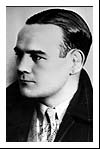
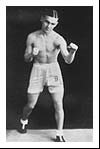
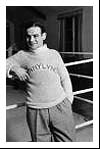
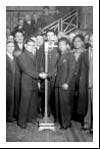
Previous Page Benny Lynch crowned world champion 1935The Florence Street which produced Scotland's first ever world boxing champion no longer exists.But the spirit of Benny Lynch remains. The tough Gorbals district of Glasgow which produced the ring's No. 1 flyweight - from 1935-38 - is gone. His achievements as a fighter look all the more amazing when placed in such a social context. Lynch was born on 12 April 1913 and began boxing as a teenager in a bid for fame and fortune to escape the poverty and deprivation of his family background. With other aspiring fighters he learned his craft at local clubs such as LMS Rovers or in the fairground booths on Glasgow Green. Lynch stood out. From an early age, he was an exceptional fighter, combining assured ring artistry with percussive punching power - unusual in a fighter whose body frame appeared so slight. He excelled as an amateur and turned professional aged 18 in 1931, stopping Young McColl in round three in Glasgow. It was the start of a career which spanned 104 bouts - most of them wins - which peaked when he won the world flyweight title in 1935 at 21. As a raw teenager, Lynch's potential was spotted by bookie Sammy Wilson who opened his own boxing club - the New Polytechnic - at No. 49 Clyde Place. Sammy spotted Lynch training at another local club and was impressed by his speed and accuracy. He signed the young boxer, and their partnership would lead to the title. Training was tough, with none of today's modern gym technology. Lynch would go on gruelling six-mile runs up Cathkin Braes. He'd spar 20 rounds a day and do special exercises to build up his scrawny neck to withstand powerful jaw punches. He even immersed his hands in brine each day - given to him by a fishmonger - to help toughen his hands.Lynch's professional record was impressive. In his first 30 fights he won 20 and drew 5.
In 1933 alone, he fought 17 times – unthinkable now. The following year Lynch claimed his first crown, winning the Scottish flyweight title by defeating Jim Campbell on points in a tough 15-rounder in Glasgow. In March 1935, he fought a draw with title holder Jackie Brown in Glasgow. Their return match - in September - was the big one. Lynch travelled to Belle Vue in Manchester to challenge Brown again for his British, European and world flyweight titles. He stopped Brown in just two rounds, scoring four knock downs in the opening round followed by a further six in round two. Lynch returned by train to Glasgow's Central Station to a hero's welcome as thousands of people brought the city centre to a standstill. His winning run continued into 1936 with nine victories including a title defence against Pat Palmer in which he won a Lonsdale Belt outright. The bout which defined Lynch's legend on the world stage came on 19 January 1937 when he defeated highly rated American fighter Small Montana in a 15-round points win at Wembley.A further defining moment came eight months later when he successfully defended his crown against Peter Kane in Glasgow…knocking him out in round thirteen. But fame dealt Lynch a cruel blow. His status as a local hero in the working class Gorbals led to money problems and alcoholism. The latter created a constant battle with the scales as Lynch fought to make the weight.He was stripped of his world title on 29 June 1938 when he tipped the scales six and a half pounds overweight prior to his bout with Jackie Jurich. In the ultimate irony, Lynch agreed to fight Jurich regardless…and knocked him out in 12 rounds. It was the beginning of the end. In his final fight - on 3 October that same year - he suffered the only knock-out of his professional career at the hands of Aurel Toma. His fighter's licence was revoked. His decline into alcoholism was rapid. His marriage broke up. On 8 August 1946, Lynch died in the Southern General Hospital of malnutrition and respiratory problems. He was 33. His friends and admirers once more brought the streets of Glasgow to a standstill as his funeral cortege made its way to a cemetery in the north of the city. Today, there is a memorial to Benny Lynch in a block of flats in the Gorbals. The plaque, while worthy, doesn't convey the true affection and admiration which remains for arguably Scotland's finest world boxing champion. The legend of Benny Lynch shines bright 70 years on. Written by: Janice Hamilton |