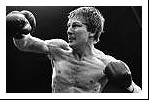
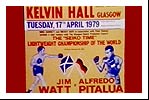
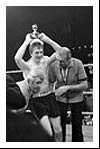
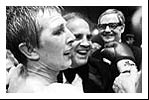
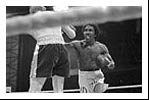
Previous Page Jim Watt wins world lightweight title 1979If popularity ensured success inside a ring, Glasgow's own Jim Watt might have been Scotland's longest-reigning boxing champion, for the blond southpaw from Bridgeton remains as popular a figure today as a TV boxing pundit as he was as a world champion between 1979 and 1981.Born in the boxing hotbed of Bridgeton in Glasgow's East End on 18 July 1948, Jim Watt's first love was soccer, but the long, harsh winter of 1962-63 scuppered the young would-be footballer's ability to play. Instead he went to the warmer climes of James Murray's Cardowan amateur boxing club at Maryhill. Despite splitting from Murray later on to join top Essex-based English coach and cornerman, Terry Lawless, no-one can deny that under Murray's early inspirational guidance the younger Jim Watt, budding but frustrated soccer player, was transformed into Jim Watt, outstanding amateur southpaw boxer. Watt was good enough to knock out - inside one round - future British European and WBC world welterweight champion, from London, John H. Stracey to take the British Amateur Boxing Association title in 1968. But even then, Jim Watt Esquire was his own man, having an independence of attitude born of losing his beloved dad at the age of 38 to bronchitis. Consequently, the young Watt had to learn to stand on his own two feet from an early age. Nevertheless, as reigning British ABA lightweight champion, Jim Watt stunned the boxing world by declining the chance to go to the 1968 Mexico Olympics to box for Great Britain.The reason? Watt had already decided to turn pro under the guidance of Jim Murray, a natural loner who ironically idolised that master of social collectivisation, Socialist MP Aneurin Bevan. In the paid ranks there was those who attributed the early Jim Watt's pro career record of only boxing at one single top class London venue in 29 bouts down to his cautious, defensive southpaw style that the boxer had evolved under Murray. However, on the plus side of this scenario, Watt was spared the early career hammerings that have ruined many a young prospect, which, in turn, explains the marvellous, unmarked freshness he brought to world-class boxing once the big career breakthrough took place. On the other hand, boxing in an ultra-defensive style led him to being referred to as 'Jim Who?' because he fought mainly (16 out of 29 bouts) in private members' clubs for what he claims was pocket money for other champions. Yet, even by this stage of Watt's ring career, the southpaw had proved his class, taking Nigerian Jonathon Dele the full 15-round distance in Lagos, Nigeria in a losing bid to win the Commonwealth lightweight crown. Then even more impressively, Watt confounded the pessimists by going the full 15 rounds with Scottish ring legend, from Edinburgh, Ken Buchanan in January 1973 in Glasgow in a defence of Watt's British lightweight title which he had won by stopping Tony Riley in Sheffield in May 1972. In losing over 15 rounds, Watt made many new friends, including Buchanan himself who admitted that southpaw Watt ahd made him toil hard for his 15-round points victory. Then there was a trip to South Africa where Jim Watt beat Springbok Andreas Steyn in his own backyard in 1972. Having split from his former mentor, Jim Murray, Watt's career was radically transformed by a telephone call from fight game manager Terry Lawless in 1976. What followed was a truly life-changing experience for Watt, as Lawless had previously admired him from a distance and had the London fight game promotional connections that James Murray had lacked.So it was that a Scottish boxing champion who used to proudly sing 'Flower of Scotland' in the ring to ringside fans had his most memorable ring triumphs choreographed for him by Essex man Lawless. Who can forget that memorable night of April 1979, in the Kelvin Hall, when, despite being hit with what Jim himself decribes as 'the single hardest punch I ever took in the ring' by Colombian Alfredo Pitalua, Watt stormed back to first deck, then stop the tough South American in the 12th round before an ecstatic crowd? Incidentally, this bout was historic because it was the first ever world title fight staged in Scotland where an American referee, New York's Arthur Mercante, who would officiate at the first Ali v Frazier heavyweight title joust in March 1971, was in charge. This Watt victory over Pitalua was the launching pad for an early 1980s renaissance in Scottish boxing, with Jim Watt establishing a record number of succesive world title defences (four) by a Caledonian champion that would last for 20 years. (His four defences was only surpassed by Scott Harrison in 2003.) These four successive world title defences highlighted the qualities that explain why Jim Watt was so effective at world level.For example, the Watt trademark toughness and courage was seen in March 1980 against Derry-based fellow southpaw Charlie Nash. The Irishman had previously accused Watt of ducking him after Watt refused to fight him in trouble-torn Northern Ireland. However, by climbing off the Kelvin Hall ring canvas in the first round of that March 1980 WBC title scrap and subsequently stopping ex-European champion Nash (who had beaten Jim Watt's nemesis, Ken Buchanan) Watt proved that he was the Irishman's master. Watt had decked Nash four times before the referee halted matters in round four. The classiness of Jim Watt's boxing skills were seen against 1976 Olympic gold medal winner Howard Davis, who also won the 'best Olympic boxer award' at those Montreal games. Howard Davis, American golden boy, and his management team of Dennis Rapaport and Mike Jones(who would later both manage 1980s heavyweight hope Gerry Cooney) swaggered into Glasgow in June 1980, cheekily asking about 'Jim Who?', a studied insult implying Watt's lack of international boxing street cred. But Davis received a painful response to his insulting rhetorical question in the rain at Ibrox Park on Saturday 7 June 1980. Davies may have dazzled the Ibrox ringside crowd with the glaring salmon pink boxing trunks that encased his flanks and which were made for the American challenger by Glasgow boxing referee and bespoke tailor, Len Mullen, but all the real razzle-dazzle came from Scotland's Jim Watt, whose superior boxing over 15 rain-soaked rounds made Watt a deserved winner. Caledonian ring great Watt also showed his ring smarts over yet another American on 1 November 1980 at the Kelvin Hall against Oklahoma's Sean O'Grady in what was Jim's last successful world title defence. Badly gashed over the eye in the later rounds by O'Grady, Watt ran away against this dangerman (73 kayos in 74 bouts) until he was in a position to cut the American and stop him in the 12th round. Smart thinking had saved the day.Overall, being the only Scottish boxer to win a title in Spain (where he outpointed Perico Fernandez in Madrid in February 1978 for the European lightweight title) and notching up a then record number of succesive world title defence wins by a Caledonian ring man, merely cemented Jim Watt's place in the Scottish ring greats Pantheon. True, Jim may have lost his world crown to Nicaraguan ring legend Alexis Arguello in June 1981, at London's Wembley Arena, but he did go out on his shield by surviving a knockdown to lose by points over 15 rounds. But there was no stigma in losing to a man like Arguello who went on to establish his own ring greatness. Courage, dignity, skill…all attributes that Jim Watt MBE still retains today and they were the same human qualities that helped transform a 1960s Bridegton soccer refugee into a classy 1980s world lightweight boxing champion. Written by: Brian Donald |