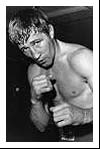
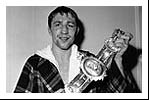
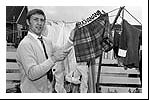
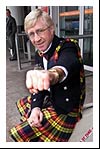
Previous Page Ken Buchanan wins world lightweight title 1970Boxing is the harshest of sports in more ways than the physical pounding in the ring. There are no intermediate stages between winning and losing. Scotland's Ken Buchanan should have been remembered as a winner for his world lightweight title, but the fight he plays over again and again in his own mind is his defeat to Roberto Duran over 30 years ago, in very dubious circumstances.Despite the patriotism of the boxer who wore tartan shorts and was piped into the ring to the tune of Scotland the Brave, he was more appreciated across the Atlantic where he won the American Boxing Writers' Association's Fighter of the Year in 1970, beating both Muhammad Ali and Joe Frazier. The southpaw is also the only living British fighter to be inducted into the International Boxing Hall of Fame. In fact he never fought a professional fight in his home town of Edinburgh, after an abortive attempt to fight in Edinburgh's biggest indoor stadium, Murrayfield ice rink, was rejected. It must have been difficult for the boxer, for whom home and family were important elements of his make-up, to never go into a ring with his home crowd cheering him on. Murrayfield's loss was Madison Square Garden's gain as Buchanan topped the bill at this most prestigious boxing venue in New York seven times, a record for a European boxer.Born in 1945 and brought up in Northfield near Portobello, Buchanan joined an Edinburgh boxing club, the Sparta Club as an eight-and-a-half year old, having to lie that he was nine, after seeing the Joe Louis film 'the Brown Bomber'. After a successful amateur career, he turned professional in 1965 and on winning 23 consecutive bouts he knocked out Maurice Cullen in 1968 to become British Lightweight Champion. He continued to progress, the only hiccup being losing on points to Miguel Velazquez in Madrid for the European lightweight title - a result Buchanan puts down to the judges favouring their own boxer. Despite this setback, the gifted boxer was given a shot at the world title in 1970 against Ismael Laguna in San Juan, Puerto Rico. Ironically the lean Scot was chosen by the promoters as a warm-up before Laguna took on up-and-coming challenger Roberto Duran. For Buchanan, the incredible 120 degree heat of a Puerto Rican afternoon was as much a problem as his talented opponent. Laguna was first out into the open-air ring and claimed the shaded corner. Buchanan's father and right-hand man Tommy had to claim a parasol from one of the spectators to offer his son some protection from the sun. Veteran British boxing commentator Reg Gutteridge said in 2002: "Laguna was an outstanding fighter at the time. Before the fight, I thought Laguna would beat him to be honest. It's very hard to win away like that. I know that the crowd shouldn't be that much of an influence but they normally are." But Buchanan's combination of elegant skills and a razor-sharp tactical brain won the fight over 15 rounds, after he decided to attack his opponent from the bell, despite the heat.However, the WBC refused to sanction this title and were backed by the British Boxing Board, who refused to recognise their own man as world champion. To add to Buchanan's feelings of rejection he returned to Edinburgh to be welcomed by a crowd of five. But the following year he beat Ruben Navarro in Los Angeles, and was finally recognised as boxing's world lightweight champion. This time Buchanan was hailed by crowds at Edinburgh Airport and journeyed into town on an open-top bus, with throngs of crowds cheering him on. For Buchanan, his most decisive fight was the defeat by the legendary Panamanian boxer Roberto Duran at Madison Square Garden in June 1972. If he had won he would have retired on the $100,000 prize money, with his head and brains still intact and his later life may have turned out differently.After 13 rounds, Buchanan felt he was finally ahead on points after the two fighters being level throughout. Instead in a few moments, which Buchanan said in his autobiography were to haunt him for the rest of his life, he lost his title after he was punched below the belt after the bell had sounded for the end of the round, which floored him. Such was the force of the punch that his testicles were permanently damaged. The referee, Tony Lobianco didn't punish the foul but awarded the bout to Duran as he decided that Buchanan couldn't continue, without asking if he could go on. It was the referee's one and only title fight and Buchanan described the punch as: "That one late blow went a long way to destroying my career." The way he lost his world title has become an obsession for the Scot, especially as he never got his promised rematch against Duran, who went on to become one of the sport's biggest stars. But the Panamanian later told Scottish sports writer Hugh McIlvanney that Buchanan was his best opponent in all of his many years in the ring. Eventually Buchanan retired on the advice of his doctor because of the damage to his left eye over the years, which meant he would always have to wear glasses. With his customary energy, he threw himself into the hospitality business, opening the Ken Buchanan Hotel in Edinburgh. Unfortunately his personal life took a downturn when his wife divorced him. He had to sell the hotel to pay for the settlement and returned to his original trade as a joiner. But Buchanan missed the ring and returned in an unsuccessful postscript to his career. In his autobiography he wrote: "If I was a runner, that would have been OK. I could run marathons and go in for age-group championships. But I was a boxer and all that matters in boxing is what you can do in the ring." Jim Watt, who Buchanan defeated in Glasgow to win Watt's British title in 1973 said in 2002: "Ken probably doesn't have the adulation he deserves. He had a wonderful career with world class achievements, but everything was done elsewhere." Written by: Gordon Cairns |