

Hill exploded on the Scottish amateur boxing scene aged 19 in 1924 when, tutored by his dad and Scotland's first outright Lonsdale belt winner James "Tancy" Lee at Edinburgh's Leith Victoria Club, he won in quick succession the Scottish flyweight and bantamweight titles.
Possessing a brilliant left jab, a crashing right cross and outstanding ring generalship, one newspaper report of February 1925 hailed Hill's victory over Glasgow's Willie Barr thus: "Hill was simply the most polished boxer on view."
In 1926 Hill not only won the British ABA flyweight title by beating English favourite Ernie Warwick in London's Albert Hall, but was awarded the Best Boxer of the Championship trophy.
 | 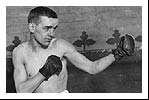 |
© Hulton Getty | |
|
Indeed, one of Alf Hill's most treasured possessions is a sepia press photograph of the Prince of Wales sitting beside their father in the NSC watching Johnny Hill stop Londoner Young Johnny Brown in the 11th round of what was only the Scot's fourth pro bout. The Daily Herald described Hill's performance that evening as an "astonishing display", and it was sufficiently sparkling to make the Prince visit Hill in his dressing room after the bout.
Eugene Corri, who refereed a bout of Hill's at the NSC wrote in a London newspaper: "The more I see of Johnny Hill, the more I am certain that he will become a pugilist of high degree."
Within a year of turning pro, Hill stopped Englishman Alf Barber in the 14th round to take the British flyweight crown (Lynch took four years to win the same title).
The following year, 1928, the European title was annexed from Frenchman Emile Pladner on points, despite being decked in the ninth round by a vicious left hook. Pladner would later win the title back by inflicting the only knockout defeat suffered by Hill.
Johnny Hill's tilt at the world flyweight title came on 29 August 1928 at Clapton Orient's football ground. There he fought Californian "Newsboy" Brown in front of 50,000 spectators. Hill won the title on points in a thrilling 15-round bout.




