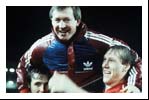
Previous Page The New Firm and the Dons' Cup-Winners' Cup glory in 1983In the days when you could go and pay to watch the match of your choice at three o'clock on a Saturday, long before Sky Television came about and moved fixtures from traditional days to the Sabbath and beyond and the match programmes were cheaper than the pre-match pie and Bovril, fans in Scotland and abroad were about to find out that there was more to the game in this country than just the Old Firm.Two clubs announced their arrival on the scene and they were here to prove that they could mix it with the Old Firm and the big boys from all around Europe. The media christened these new kids on the block "The New Firm". Both these clubs would give the Old Firm a run for their money in the fight for league and cup glory and they would also give their fans and football fans in general some great European nights to be proud of. Youngsters nowadays think that only Celtic and Rangers have been the masters of the Scottish game, but both Aberdeen and Dundee United have a story to tell in the Scottish game, particularly in the 1980s. Both clubs had great players in their respective sides but the two men in charge of these football clubs were winners and that rubbed off on their players. These two characters were respected by players and fans alike. Both Jim McLean's and Alex Ferguson's paths would cross on many occasions in their quest to claim silverware. One such occasion was the 1979/80 League Cup final. After the stalemate could not be broken in a 0-0 draw in the first match at Hampden, both clubs had to go to Dens Park for the replay. This time there would be no doubt of the outcome. United were the hungrier team right from the start and it was no surprise when they won the match by three goals to nil. Two goals from Willie Pettigrew and one from Paul Sturrock gave the Tangerines the trophy, the Tannadice club's first major trophy in 69 years and boy did they enjoy it! United had beaten a team that on their way to meet them had beaten both halves of the Old Firm - this was an achievement not to be sniffed at. McLean's men now knew they had the chance to be a major threat to the Old Firm and their newest rivals, Aberdeen. But was this just a one-off or could United build on this win and give the manager and their fans more success? The following season, the League Cup again would provide a cause for celebration. The Bell's League Cup final would again be at Dens Park and this time in the way of United's quest for glory would be their city rivals and first division team, Dundee. Dundee had home advantage in this derby match but that did not matter. United were a league above Dundee and in this match they would prove a class above them. Goals from Davie Dodds and two from Paul Sturrock kept the trophy in the Tannadice trophy room - they seemed to have a liking for this tournament and for Dens Park in particular. The question was, could United now make it a hat-trick of wins in this competition? The venue Hampden, the opponents Glasgow Rangers. Unfortunately there was to be no happy ending this time for United as Rangers won the match 2-1. United did not have the same good fortune in the Scottish Cup finals that they featured in. They appeared in four finals during the eighties and lost all four! In 1981 they lost 4-1 to Rangers in a replay after a 0-0 draw, 1985 they lost 2-1 to Celtic, 1987 they lost 1-0 to St Mirren and in 1988 they lost again to Celtic 2-1. In both matches against Celtic, United were in front (it is ironic that in United's two other cup finals in the '90s they lost 4-3 to Motherwell and when Ivan Golac was the manager they actually beat Rangers 1-0 to win the cup after so many heartbreaks when Jim McLean was in charge). With United's thirst and hunger after League Cup wins the question remained: could they now take on the Old Firm in the marathon of the League Championship? Season 1982/83 will go down in history as one of the best that the Tangerines fans have ever seen. In a season that started with a match against Aberdeen and also included fixtures against both halves of the Old Firm and a match against city rivals Dundee, some might have thought that the fixtures would conspire against them, but under Jim McLean that could never be.In a roller-coaster season that would go right to the wire United would soon prove that they had come of age. The Old Firm were beaten, New Firm rivals Aberdeen too. Now it was down to the last day of the season and their favourite venue Dens Park for a match against city neighbours and rivals Dundee. Saturday 14 May would be D-Day at Dens: no matter what was happening elsewhere this was the place to be. Tension, nerves and 90 minutes of nail-biting action for the crowd to suffer, this was what it had all come down to. It took United only four minutes to ease some of that tension with a superb opening goal from Ralph Milne, a great chip from outside the area - a goal fit to win this or any other championship - but this was only the start. United were to go further ahead but not before a heart-stopping moment when David Narey went charging into the box and he was upended by McGeachie - a penalty no doubt. Eamonn Bannon took the kick, Kelly parried the shot, but Bannon was on hand to smash home the rebound. United were in dreamland now but Dundee were not just going to roll over; they still had a heart-stopping moment or two in store for their neighbours. Ian Ferguson was to score for Dundee to make it a nervous time for the United players but Jim McLean's men held on and clinched their first ever championship in their 79-year history and how the United fans loved this! The players carried Jim McLean shoulder high as sheer emotion took over. United had done it, they had gone the distance and came out on top. A new record of scoring 90 goals as United's attacking play was rewarded. 56 points, one ahead of both Celtic and Aberdeen in an incredible championship race that United deserved to win. Tayside was going to party from Saturday right through till their beautiful Sunday! Throughout the '80s United had many memorable nights in Europe, playing teams such as Manchester United (2-2 at Old Trafford, losing 3-2 at Tannadice), getting to the quarter finals stages twice in both 81/82 and 82/83 and beating the likes of PSV Edinhoven, Werder Bremen, AS Monaco, Borussia Monchengladbach. But with winning the Premier League came a place in the European Cup. In a superb run they beat Hamrun Spartans, Standard Liege, Rapid Vienna en route to a semi-final appearance against Italian giants AS Roma, winning the first leg 2-0 but going down 3-0 in the second leg, a heartbreaking end to a truly superb run from the Tannadice men. As that European adventure ended, three years later another European adventure would begin. The other half of the New Firm, Aberdeen, would become a major thorn in the side of not just the Old Firm but United and also some of the very best teams from around Europe. Hard lessons had been learnt from previous European ventures and heartbreaks in cup finals in previous years. But Scottish and European football were about to witness a major force – a team from the north called Aberdeen and a manager called Alex Ferguson! Not since 1954/55 had Aberdeen been able to win the Scottish Championship but the team in 1979/80 were about to write their names in the history books of this great club. Players who were nearly men would now become winners and the fear of playing the Glasgow giants would be no more. Alex Ferguson could not understand why players would celebrate a draw with Glasgow's big two like a victory. Things would have to change and quickly if the Dons were to be successful and if the club was to challenge the Glasgow clubs and United for major honours in the Scottish game. The Dons had heartbreak in both Cup competitions, losing to Dundee United in the League Cup final replay 3-0 and 1-0 to Rangers in the Scottish Cup semi–final the same season but soon the Pittodrie fans would have very good reason to celebrate. Aberdeen had a poor start to the season but this was not a sprint, it was a marathon, and the Dons would go on a late 15-match undefeated run from March to May with two wins in Glasgow against Celtic on their relentless march towards the title. Easter Road and a match against Hibernian would be the place every Dons fan would want to be. Their sparkling football swept Hibs aside and they won the match in a canter 5-0! The manager, players, and fans had waited so long for this moment; the heartbreaks of previous defeats in Cup Finals of the past would all came out in an over spill of sheer emotion and the Dons fans would paint Edinburgh red and white instead of green and white. The Dons had won the League for the first time since 1955 that strangely enough finished one point ahead of nearest challengers Celtic. This Dons team would do the very same. Maybe it was written in the stars that this would be the year that the Dons would be crowned champions. Winning the Championship would bring the Dons a chance to play in the European Cup and after seeing off Austria Memphis with a Mark McGhee goal giving the Dons a 1-0 win on aggregate the Dons would now face the pride of England and former winners of the European Cup, Liverpool! The whole country could hardly contain their excitement! Liverpool were to teach their Scottish counterparts a hard lesson, winning 1-0 at Pittodrie and thrashing them 4-0 at Anfield. Their European adventure was over. This was to be a disappointing season for the Pittodrie club finishing second in the League and going out of both cup competitions - to Dundee 1-0 in the League Cup and Morton in the Scottish Cup 1-0. Indeed the only time the Pittodrie trophy cabinet was opened was when the Drybrough Cup was won at Hampden with a 2-1 victory over St Mirren. Steve Archibald was sold to Spurs and Joe Harper, the King of the beach end, had come to the end of his time at Pittodrie.The Dons would have to rebuild and Fergie wasted no time in doing so. In season 81-82, the Dons brought in Peter Weir from St Mirren and youngsters like Cooper, Simpson, Black and Hewitt would now become favourites with the Pittodrie faithful. Yet again the Dons would start slowly, losing their first two matches 4-1 to Dundee United and 3-1 to Celtic, but they soon gathered momentum, not losing to Rangers all season but only beating Celtic once in the League. This was not enough and the Parkhead club took the title. The League Cup interest was again ended by Dundee United despite winning the away leg 1-0 they crashed out losing 3-0 at Pittodrie. The UEFA Cup would provide the Dons fans with another battle of Britain in the first round, with the holders Ipswich being drawn together with the Dons and few down south gave the Pittodrie club any hope. However, they would soon find out the Dons had a few aces up their sleeves and none more so than Peter Weir. After a 1-1 draw at Portman Road the English came north and were sent homewards to think again. That second leg at Pittodrie could be dubbed the Peter Weir show as the winger tore the UEFA Cup holders apart. The Dons beat Ipswich 3-1 and sent the fans wild with delight. The Dons now faced Arges Pitesti and they progressed with a 3-0 first leg win and a 2-2 away draw. This set up a clash with German giants SV Hamburg and after a 3-2 win at Pittodrie the club would go out of Europe, losing 3-1 in Germany and 5-4 on aggregate. The only cup competition left for the Dons to focus on was the Scottish Cup and they were given a tough task with an away draw at Fir Park to play Motherwell. The club did not waste any time with John Hewitt scoring the only goal in nine seconds to knock Motherwell out of the Scottish Cup. What the Dons wanted now was an easy home tie and they got the home tie that they wanted but it was against Celtic. One goal was enough to settle the tie and again it was John Hewitt who would prove to be the match winner: the Dons were now on their way. Kilmarnock were next at Pittodrie. The Dons won this match 4-2 and that set them up with a semi-final meeting with St Mirren. The first match at Celtic Park would see both teams fight out a 1-1 draw and so this match would have to go to a replay at Dens Park; the Dons would come out on top (3-2) in a five goal thriller. The Red army was now on the march to Hampden to face Rangers in the final. The Dons had played Rangers the week before at Pittodrie and hammered them 4-0 with John Hewitt scoring a hat-trick So they went in to this Hampden final with nothing to fear but things did not go plan. They had fallen behind to a John McDonald goal, but the Dons would soon hit back and what a goal it was! A superb curling effort from the edge of the box brought the Dons level and with no more scoring in the 90 minutes the match would go into extra-time. In the extra half an hour that was played, the Dons would outplay their tired Glasgow rivals and goals from Mark McGhee, Gordon Strachan and Neale Cooper sent the Dons fans wild with delight and the Cup was heading north to Pittodrie. Season 82-83 would be a season that no Dons fan would forget in a hurry. On the domestic front, the League campaign went to the wire but both they and Celtic would lose out by a point to Dundee United who were crowned champions. United would also end the Dons involvement in the League Cup losing 4-1 over two legs so the Pittodrie faithful had only the Scottish Cup and their European Cup-Winners' Cup to look to for any hope of silverware. In Europe the Dons were going about their business and had already seen off Sion, Dinamo Tirana and Lech Poznan before being handed a stiff task with the German giants Bayern Munich up next for Aberdeen. The Dons knew this was always going to be a hard match but they gave themselves a great chance with a 0-0 draw in the away tie in the Olympic Stadium in Munich with a backs-to-the-wall performance, Leighton, McLeish and Miller earning their cash in a great team performance. With the tie finely balanced, Pittodrie was a sell-out for the second leg as the mighty Bayern Munich came to town. Not for the first time things would not go to plan, and if the Dons would progress any further in Europe then they would have to do it the hard way. The Germans were in front twice in the tie, 1-0 then 2-1 with Neil Simpson levelling for the Dons before the Germans edged back in front in the match. Fergie sent on super sub John Hewitt to see if he could get on the end of anything that his side would create. With time running out the Dons won a free kick. Gordon Strachan and John McMaster feigned a mix-up over who was to take the kick. Suddenly, as the Germans fell for the ploy, Strachan turned and played a perfect ball on to his fellow red head Alex McLeish. The big defender rose above the Bayern defence and headed the ball into the net. The Dons had drawn level but that would not be good enough, they would still be out of Europe. Almost immediately, a long ball found the head of Eric Black who headed goalwards and as the keeper parried the ball out, super sub John Hewitt was on hand to knock the ball under his legs and into the net. Pittodrie went berserk! The cheers from the Dons fans could be heard all around Europe! They had came from behind and knocked out the mighty Bayern Munich! The semi final draw paired the Dons with Waterschei of Belgium and the home leg was first so the Dons would want a decent advantage to take to Belgium for the second leg. No-one could have imagined the Dons taking a four goal advantage with them as they swept a side the Belgians with a 5-1 win and a superb performance from Dougie Bell! In the second leg they were to lose 1-0, their only defeat en route to the final. You would have thought that they had just gone out of the tournament such was the mood in the dressing room, but that was the standard set by this Aberdeen team. Yet the Dons had done it, a European final against the famous Real Madrid beckoned. Gothenburg would be a place that the Dons fans would keep close to their hearts as 11 May 1983 would be the Dons' day of destiny. Fans made their way to Sweden via the St Clair ferry, by car, by plane and any way they could to see their heroes take on Real Madrid in the Cup-Winners' Cup Final. In Sweden the heavens opened and the rain poured down. Would this help the Dons? The fans and players did not care as they got soaked in the Swedish rain as their heroes were about to face the biggest match in their lives. A good start to the match was needed and after Eric Black had smashed the crossbar with a great volley the Dons took an early lead. A Gordon Strachan corner was headed on by Alex McLeish only for Eric Black to turn and spin on the rebound to put the Dons 1-0 in front. The Dons' joy was short-lived as a short back pass from Alex McLeish was latched on to by Santillana as it caught up on the wet pitch and Jim Leighton had no option but to bring him down. Real were awarded a penalty from which Juanito scored to make it 1-1. The Dons' spirits were as damp as the Ullevi pitch! But this team knew that they had come a long way, they did not come this far to lose, not even to Real Madrid. Chances would be missed by both sides and this match would go into extra-time, someone would make themselves a hero! That man would be the superb sub who had come on to replace the injured Eric Black, who landed badly on an ankle as he came down from heading the ball over the bar. John Hewitt would come off the bench and make himself a hero for life. But not before nearly being subbed himself! Fergie and Archie Knox thought that they would have to take John off as the ball was getting stuck in the pitch as John tried to run with the ball. Thankfully for the Dons fans they did not! The magnificent Peter Weir had left at least three Madrid players in his wake as he went on one of his famous runs. He then chipped the ball to Mark McGhee who somehow got the ball on to the head of John Hewitt as the keeper missed the cross. Hewitt's header landed in the Real net and as the super sub danced a jig of delight the Dons fans went mad! Was this really happening? The Dons had beaten the famous Real Madrid 2-1 to win the Cup- Winners' Cup and from Sweden to back home in Aberdeen the northern lights would shine brightly tonight as proud fans danced and sang their way through the night as their team were now European winners! But domestic success was still the bread and butter for the Dons and after all the highs of winning the Cup-Winners' Cup they still had to put all their celebrations behind them as a Scottish Cup Final against Rangers was still on the cards. It may have been tiredness or over celebrating but the Dons failed to lift their game for the Rangers match but yet again as they had done on so many occasions, in extra time the Dons won the match. A goal from Eric Black gave the Dons their second Scottish Cup win in two seasons over Rangers but this was not enough for the manager as after the match Alex Ferguson would rip into his team for there sub-standard performance. Just to round off the year, in the December of 1983, the Dons would face Hamburg, the winners of the European Cup, in the two-legged final of the Super Cup. After a 0-0 draw in Germany they would bring them back to Pittodrie with some old scores to settle. The Dons won the match 2-0 with goals from Neil Simpson and Mark McGhee to lift the Super Cup and become the only Scottish team to win two European trophies, still a fact to this day. The Dons would also be named European team of the year: now they could really say to the Old Firm fans that Aberdeen was the best team in Europe! In season 83-84 the Dons would win the League title with a goal from new signing Stewart McKimmie gave them a 1-0 win at Tynecastle, and they would also win the Scottish Cup for the third time after beating Celtic 2-1, again after extra time. Before Alex Ferguson left in 1986 the Dons would win the Cup double, beating Hibs 3-0 in the League Cup and Hearts 3-0 in the Scottish Cup. Everyone who played for or supported Aberdeen or Dundee United, or the New Firm as they were called, will never forget the glory days that those clubs were involved in. When the Old Firm and some of Europe's best were beaten en route to some of the greatest nights their clubs have ever seen. There was a time when the football lights shone brighter on the teams from the north rather than the big two in Glasgow but the question still remains, will those clubs ever be able to repeat those nights again? Written by: Sean Graham |