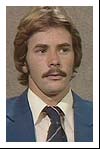
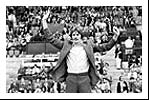
Previous Page David Wilkie wins gold in Montreal 1976Certain things trigger vivid recollections of the 1970s; the music of Emerson Lake and Palmer, Adidas T-shirts or footage of David Wilkie standing on the podium at the Montreal Olympics wearing his red white and blue tracksuit, all bring back memories of the never-ending summer of 1976.And in a way the Scottish swimmer could be considered the quintessential seventies sportsman ahead of Kevin Keegan or Henry Cooper. When everything considered cool was American, from Charlie's Angels to The Eagles, the tall Edinburgh-based student crossed the Atlantic to train and study in Florida and picked up the accent. He even looked American due to his centre parting, moustache and choice of interesting knitwear. Wilkie seemed to bring a seventies laid-back temperament to his sport at odds with today's ultra-competitive win-at-all-costs mentality, even though he was competing at the highest level by winning Olympic medals and breaking world records. But the reason why Wilkie has come to encapsulate the much-vilified decade is that he walked out of the public eye at his peak. After winning the Olympic gold in the 200m Breaststroke at the Montreal Olympics in 1976, he retired. He did not grow old in the public eye and so Wilkie will be remembered forever as the young moustachioed swimmer and for the general public will forever remain 22 years old. He spent his first 11 years in Sri Lanka before moving to Edinburgh to go to boarding school at the David Stewart College and then moved to America as an 18-year-old to go to university. It was little wonder that he should lack a distinctive Scottish voice. It did not make him feel any less Scottish. He said in a BBC interview in 1976, while at college in Miami: "I will always remain Scottish, no matter what happens, even though my accent changes, even though I live in this country, I still maintain I am Scottish. "I always will do, even though I have only lived half my life there." It's fair to say that if his parents had not decided to move to Sri Lanka before he was born, he would not have made it as a world champion swimmer. As a child he would stay in the pool for hours on end or go down to the beach and swim in the sea. This would have been far more uncomfortable for the young Wilkie if his parents had chosen to stay in Aberdeen rather than move out to the Far East where his father worked on a tea plantation. Wilkie's second stroke of good fortune was to go to boarding school in Edinburgh where the Warrender Club was based, famous for developing young swimmers.But Wilkie's laid-back attitude may have brought his fledgling career to an early end. He got into trouble at the club on a number of occasions for missing training sessions. And he struggled to get out of his bed to make the early morning trainings sessions. But when Wilkie was only 12, the club's coach Frank Thomas spotted something in the ex-pat, although it was not until 1970 that the promising swimmer began to shine. Between 1969 when he won the Scottish Junior title and 1970 when he won bronze at the Edinburgh Commonwealth Games, Wilkie shaved an incredible 30 seconds off his time in the 200m breaststroke. It was his performance at the 1972 Munich Olympics when the 18-year-old came from virtually nowhere to take a bronze medal that he began to really show what he was capable of. The performance won him more than an Olympic medal. The University of Miami who had been monitoring his progress decided to offer him a sports scholarship, which enabled him to train every day whilst studying for a marine biology degree, which he soon switched for a degree in English and Mass Communication. Not surprisingly he thrived under the American scholarship system. Then as now, not a lot of money was spent on swimming in Scotland and Wilkie had to fit his training schedule around seven different pools, but in Miami Wilkie trained in the Olympic-sized outdoor pool every day.Wilkie especially enjoyed training outdoors as it broke the monotony of the four-hour-long training swims and he said in 1976: "It's really nice training out in the sunshine." In the days when Olympics were still strictly for amateurs, being allowed to dedicate himself to his sport brought the best out in Wilkie. And the States was the home of all the top swimmers. Wilkie was the only non-American to win one of the 13 gold swimming medals available at Montreal, the first British man in 68 years to do so. In 1973 he went to Belgrade and won the World 200m breaststroke title, breaking the world record, and then regained the title in 1975 while adding the 100m breaststroke to his conquests. At the Commonwealth Games in Christchurch in 1974 he picked up two golds and one silver and also added the European title to his collection. On the world stage his biggest rival was the American John Hencken. It was Hencken who won the 100m at Munich when Wilkie came in third and the two men had an intense rivalry for all of the breaststroke titles of the early '70s. According to the British Olympic coach Dave Haller, Hencken had the beating of him for speed because of his fast arm movements and was more suited to the sprint of the 100m, but Wilkie's long rhythmic strokes meant he was better over the longer distance. The swimmers' competitiveness stopped them being friends and the amiable Wilkie had to admit the athletes barely spoke to each other. He added: "We don't hate each other but we regard each other as the main rivals in the breaststroke and it's just we've not progressed beyond speaking two or three words to each other."Honours were shared at the Montreal Olympics. Hencken beat Wilkie into second place in the breaststroke with the top three in this race all breaking the world record. Wilkie was pleased with his second place, especially as he hadn't prepared as thoroughly as he might by not shaving off his body hairs, which could cause drag under water. And in the longer distance, Wilkie dominated his American opponent, beating him by metres and taking three seconds off the world record in the process. And then he retired at the top. Leaving a legacy of being Scotland's best ever male swimmer and introducing the combination of swimming caps and goggles to swimmers everywhere. Written by: Gordon Cairns |