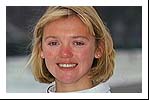
Previous Page Shirley Robertson wins second Olympic gold 2004There can be no surprise when an Olympic gold medal sparks a flurry of interest amongst press and public alike in a minority sport in our success-starved nation, but introducing a new word to Scrabble boards across the country is an unusual bonus.Last summer very few people had heard of yngling, never mind picking up the 72 points on the Scrabble board available, until the intervention of Shirley Robertson. Yngling simply describes the boat; a cross between a planing dinghy and a keelboat which Robertson sailed, with Sarah Ayton and Sarah Webb, to gold at last summer's Olympics in Athens.
The winner's medal won by the 36-year-old Clackmannanshire sailor at the Athens Olympics was doubly remarkable. Winning her first gold at the Sydney Olympics in 2000 made Robertson the first Scottish woman to win an Olympic gold in an individual event, when she sailed her Europe class yacht to victory.
And winning her second gold meant she has equalled the Spaniard Theresa Zabell as the female sailors who have won most Olympics golds. That she changed from sailing single-handedly in a Europe-class yacht to face the completely different challenge of skippering a three-man yngling, says a lot about Robertson's character. After winning her gold at the Sydney Olympics she was close to retiring because she had peaked at the sport and had no new challenge to face. Instead she simply changed her type of craft. Ironically, earlier in her career many in the sailing community wondered if she had the right temperament to reach the very top in her sport, as her ability merited. She mastered her new discipline in some style. With teammates Sarah Ayton and Sarah Webb, the British girls won their golds with a day to spare, after overcoming their closest rivals the Danes and Ukrainians. In the immediate aftermath of her victory, Robertson modestly down played her role in the victory. She said: "I'm overwhelmed that we managed to put it all together. I can't praise the other two enough. "I'm absolutely thrilled. After all, I'm only the driver; I steer the bus." However, Ayton spoke of how their veteran captain kept them focused: "For sure Shirley calmed us down. We were a little bit nervous. She just kind of keeps it real before the start of races, while you can see other crews doing and saying all sorts of stupid things. "Throughout the three years we've been together in this class, Shirley always works 100 percent. She expects no less from myself and Sarah Webb in return. At any regatta with Shirley she always gives it to you straight down the line and we respect that." Robertson was brought up in Menstrie, near Stirling, and first set sail at Loch Ard in the Trossachs as a child with the encouragement of her father, Ian, who built her first dinghy in the family garage.
At her first-ever regatta at Linlithgow in her teens, she recalls spending half the race being turned upside down. She progressed in her sport and went to the Barcelona Olympics in 1992 at the age of 24 with high hopes of winning a medal, but didn't make an impression on the opposition until the following Olympics in Atlanta. Her ninth place in the Catalan capital was creditable for a relative novice but Robertson felt embarrassed at how unprofessional she was compared to her rivals. Taking this lesson onboard, she began practising to the point of obsession for the 1996 Olympics in Atlanta. The former head girl at Alva Academy was in contention for a medal until the last race when she slipped to fourth but the general consensus was that she was not defeated by other competitors but by her own frame of mind. Ahead of the Atlanta Games, she was so preoccupied with what she called her need to win that an obsession with victory became self-defeating, stopping the potential of this technically excellent sailor. Once she had conquered her own demons, doubts about her temperament disappeared and Robertson allowed her class to shine through. At the Sydney Olympics she led from the start, but was pushed to the end in a rigorous examination of her mental toughness. In the first race of the final day she was placed a lowly 16th, allowing Margriet Matthysse of Holland to cut her lead to five points with one race to sail. Silver was secure but the real test was making it gold. Matthysse won again, but needing to be at least fourth, Robertson managed a fighting third. Her will to win had never diminished. It was just a question of controlling it. But there seems something perverse in the fact that throughout her long and successful career her major concern has been whether she can she continue financially, when as a country we allow thousands of mediocre footballers to make a living. In 1995 she stated defiantly: "If I'm in debt, then I'm in debt. I don't care how much anything costs. I always live at my credit limit. I go from overdraft limit to overdraft limit with a wallet full of credit cards. When you're trying to be the best in the world, debt is irrelevant." But with the introduction of National Lottery funding in 1998, Robertson could focus fully on sailing rather than raising money. Jumping ship to Yngling brought the blonde Scot new financial problems. As well as being the newest class, Yngling is also the most expensive. "I had just got married and had reached an age where I didn't want financial issues to impact on my domestic situation," said Robertson. Major sponsorship from Volvo and a host of dinners and sponsorship pledges supplied the rest allied to lottery support. Can Robertson maintain her hunger for success until the next Olympics in Beijing in 2008? Perhaps she gave a clue when she said: "I've always felt comfortable in a boat. It's a nice place to be." Written by: Gordon Cairns |