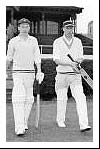
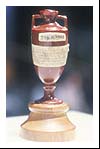
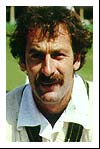
Previous Page Mike Denness Wisden Cricketer of the Year 1975Cricket may not be the first sport you associate with Scotland, but there have been a few players from this land who have scaled the heights of the game and have left an indelible mark on the sport. One of these is Michael Henry Denness, who grew from watching the local side play next to his Alloway home to become captain of the English national team in an ashes series.Mike Denness was born in Bellshill in 1940 and he picked up the sport after his family moved to Ayr, whose ground was just along the road from his house, in the shadow of Burns' Cottage. It was obvious from his displays at club level that he was someone destined for greater heights, and it was no surprise when he won his first of ten Scottish caps when still only 18 in 1959. A move south to turn professional in England was obviously on the cards, and only three years later, at the tender age of 21, Denness was on his way to Kent, a county he was destined to serve for fifteen years of a long and distinguished career, becoming captain in 1972. This period, the turn of the 1970s, saw Kent as a dominant force in English County cricket, and with the suave, elegant Scot at the crease Kent began to collect trophies, starting with the Gillette Cup in 1967. Once Denness took over the captaincy, the trophies started to add up at Canterbury, with another Gillette Cup, a Benson and Hedges Cup and three One Day League trophies being joined in the trophy cabinet by the 1970 County Championship. Personal recognition of these achievements came in 1975, when Denness was announced Wisden Cricketer of the Year. His club success continued after he moved to Essex in 1977, with another County Championship win in 1979 at the tail end of Denness's career. However, despite all his successes at County level, it is for his exploits as an international that Denness will always be remembered. Leaving behind the limited international opportunities of his home nation, Denness gained his first cap for England in 1969 facing up to New Zealand at the Oval. With his excellent batting and fielding abilities it was not long before he became a fixture in the English one day and test sides. In his international career Denness was to amass 28 caps, but it is for one spell in the mid 1970s that he will always be remembered. In 1973, Ray Illingworth was dismissed as England captain, and the selectors decided that in the elegant right hander, Denness, they had the perfect replacement. The man from Ayr followed in the footsteps of “Bodyline” captain, Douglas Jardine from the 1930s and became a Scot captaining England. One man in particular was none too happy at the appointment however. England's mercurial batting talent, the brusque Yorkshireman Geoff Boycott, made no secret of the fact that he fancied the captaincy for himself, and this essential part of the England make-up was only to play in the first six tests of Denness's captaincy.The loss of Boycott was practically a fatal blow to England's chances in the Ashes of 1974-5. England captains are judged on their performances against Australia, and Denness must have known he was in for a rough ride as his team faced up to the might of Dennis Lillee and Jeff Thomson in the Australian attack. The tour turned into a nightmare for the visitors, with Thomson and Lillee wreaking havoc amongst the English batting – at one point in the series Denness even dropped himself for a match. However, the dependence of Australia on their two pacemen was shown in the final test, when both were injured and England won comfortably. Denness came home to a none-too friendly reception from the press, and all eyes turned towards the next Ashes, which would be on home soil, to see if things would change for the better. The first test at Edgbaston was to show that if anything had changed in the past year, it was only that the Gods had joined Boycott, Lillee and the Australians to conspire against Denness. England won the toss and put Australia in to bat, to which they replied with an impressive, but not unreachable 359. However, as England began their reply, a huge thunderstorm erupted, the wicket became a bowler's dream and England collapsed for 101 in their first innings, and only managed 173 in their follow on. At this point the press had a field day demanding Denness's head. Criticism was levelled from all quarters, some of which had an unsavoury edge regarding Denness's nationality. After the first test the England selectors caved in to the pressure and replaced their captain, to which Denness reacted with characteristic grace and politeness and he returned to his successful county career never to play test cricket again.Denness was not replaced by Boycott, but instead by Tony Greig. The Ashes series was marred by vandals destroying the wicket of the Third Test, resulting in its abandonment, and England went on to lose the series 1-0, with the other three played tests drawn. Despite the controversy over his time as England captain, and the occasional controversy he causes as an ICC Referee, the facts of Mike Denness's career speak for themselves, with a phenomenal 25,886 career runs, four test centuries and a highly respectable test batting average of 39.69, Denness not only ranks as the greatest ever Scottish cricketer, but as one of the game's all-time greats. |