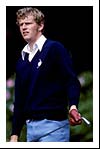
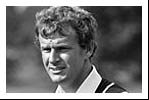
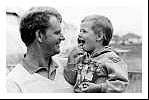
Previous Page Sandy Lyle's Open triumph 1985The British Open has always been regarded as the most prestigious major event in world golf, with the claret jug easily the most recognisable and desirable trophy for golfers, beating even the US Masters' much-coveted green jacket into second place in terms of tradition and significance.All of the golf's top names have grasped the Royal and Ancient's main prize, which was commissioned from MacKay & Cunningham of Edinburgh in 1873, although in modern times the record of British players in the competition is not overly impressive. The immediate post-war era was dominated by the South African, Bobby Jones, and Peter Thomson, an Australian, who won the tournament no fewer than eight times between them in the ten years after 1949. British successes were few and far between, as top-class competitors in the shape of Jack Nicklaus (a three-time winner), Tom Watson (five times) and Arnold Palmer (twice), kept a firm hand on the trophy from across the Atlantic. Tony Jacklin did manage to momentarily crack the foreign monopoly, with a win at Royal Lytham and St Anne's in 1969 and on that day helped lay the foundation of what was to become the next British triumph. After coming close to catching Jacklin's winning match ball as he victoriously hurled it into the crowd, an 11-year-old from Shrewsbury, who would later represent Scotland, vowed that one day he would be united with the famous jug. And so it came to be 16 years later. Sandy Lyle, son of teaching professional Alex Lyle, triumphed at Royal St George's and with it struck a significant blow in cracking America's domination of the sport. Lyle had been a professional for eight years prior to his first major victory, winning the prestigious Rookie of the Year accolade in 1977. His career, especially in its latter stages, was blighted by inconsistency and he was renowned throughout the game as a likeable character whose form could change as quickly as the unpredictable British weather.However, on the final day of the tournament in '85 everything clicked into place for the adopted Scotsman. Three strokes behind overnight leaders Bernhard Langer and David Graham, he set about eating into their lead and came into his own on the back nine. In true Scots style, his victory had to come the difficult way, and his hopes looked forlorn after a wayward drive on the 14th hole. Luckily he managed to dig his ball out for an unexpected birdie, before battling towards the 18th tee with victory in his sights. Once again it did not go to plan. His ball rolled and rolled and rolled until it slipped off to the left of the green, then his delicate chip did not catch the top of the gradient. However, a further two shots were all that he required to win the tournament, beating the late Payne Stewart by a single shot.And so a Scot had finally won the Open, for the first time since Tommy Armour in 1931. Lyle's career was instantly enhanced and he followed up his St George's triumph with a historic Masters win in 1988, becoming the first non-US citizen to don one of the famous green blazers. Lyle's 1980's successes helped inject confidence into European golf, something which is particularly evident in the continent's impressive Ryder Cup record from the 80's onwards. Lyle had taken the Masters for Europe and for Scotland, and with it put the little country which had invented the game 150 years before back into the forefront of golf's mind. At last Scotland had a true world champion and the European game, as a result, was given new credibility. Players like Nick Faldo - who collected his Masters green jacket only 12 months after Lyle - Seve Ballesteros, Sam Torrance, Bernard Gallacher, Mark James, Jose Maria Olazabal, Ian Woosnam, Colin Montgomerie and Langer, some of whom can claim more major triumphs than Lyle ever achieved, were now able to go across the pond and routinely win in the American's 'back yard'. Lyle's illustrious career fizzled out in the early to mid-1990's, but he has remained one of the most respected and liked characters in golf and was in the running to become Europe's Ryder Cup captain for the 2007 championship at the K-Club in Ireland.How ironic it would have been for the man who did so much to end the US domination of golf to have led the Europeans to a record breaking third successive Ryder Cup victory? Written by: Robert Thomson |