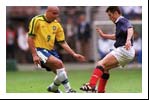
Previous Page Scotland Open the World Cup 1998It was undoubtedly the biggest stage on which Scotland's national football side have ever performed. Paris in the June sunshine and the Stade de France was packed to the rafters for the inaugural fixture of the 1998 World Cup. Indeed the brand new French national stadium, situated in the industrial northern suburb of St Denis, could never have coped with the demand for tickets even if it had been capable holding four times its 80,000 capacity. Over 60,000 Scots were estimated to have descended on Paris for this fixture against the cream of world football, for the opposition that summer's day were none other than the four-times winners, the world champions, the inventors of 'samba soccer', the one and only Brazil.The build up to this game had gone on for months beforehand, indeed ever since the draw had pitted the Scots and the South American superstars together. Many Scottish families organised their summer holidays around this fixture and even though the chances of getting a ticket were wafer thin, the game created a huge buzz around the Scottish football scene. Many fans felt the need to just be in Paris for this game. Nothing else seemed to matter in the days before the game. Scotland versus Brazil dominated the news, getting hours of television coverage, pages and pages of newspaper space and practically taking over the radio airwaves. This was the nearest that Scotland had ever been to a World Cup Final and every Scot was being encouraged to enjoy the occasion. On the morning of 10th June 1998, the day of the game, one of the Scottish tabloid newspapers carried a full, front-page image of a very distinctive cloud formation, in the shape of a saltire, St Andrew's Cross, which had been photographed over a clear blue Paris sky the previous afternoon. Their line was that this was a sure sign from the heavens that the Scots would triumph in this their greatest footballing moment. The nerves were jangling as the Scottish team had to endure the endless trials of the tournament's opening ceremony, before both sets of players finally took to the field.
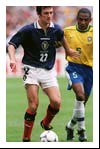
After a rousing rendition of “Flower of Scotland”, from both players and the massed tartan-clad fans who had managed to get into the stadium, the Spanish referee Senor Aranda blew his whistle and the 1998 World Cup was started. The early exchanges were littered with elementary errors, no doubt fuelled by nerves on this momentous occasion. During this period, Scotland conceded an early goal, giving us the worst of possible starts. Rivaldo curled in a corner to the near-post, big defender Cesar Sampaio rose unchallenged at the six-yard box and powerfully headed the ball goalwards and past Leighton. The ball hit the net and with Hendry, Collins and Burley all looking accusingly at each other the world champions wheeled away and celebrated together. The goal, which had put Scotland behind, was in essence so simple and so easily preventable. It was the type of goal which one could see at any Scottish ground on any given Saturday. Conceding a goal so early had really given Scotland a mountain to climb. Craig Brown's men would have to show remarkable character just to avoid a drubbing from here.Yet, from the ashes of disaster the phoenix did rise. Scotland showed a composure and class that had been rarely been evident in recent years and this, combined with an indomitable fighting spirit, saw them slowly but surely find their way back into the game. A pattern began to emerge, not the expected pattern of Brazilian dominance which many had predicted, but that of an extremely tightly contested game. Brazil may have been gifted an early lead, but the Scottish team, with Colin Hendry having a huge game at the back, the experienced Paul Lambert, with great support from John Collins and Darren Jackson held their own in midfield and Kevin Gallacher perhaps having his finest moments in a dark blue jersey up front, were not in the mood to gift them an easy three point starter in this vital qualifying group game. Kevin Gallacher's pace was always a threat to a slow Brazilian back line. It was an extremely combative, but never a dirty game, although Darren Jackson did overstep the mark, being booked by Senor Aranda after 25 minutes. Brazilian goalscorer Cesar Sampaio was the only other player to be booked, receiving a yellow card in the 37th minute. Sampaio was booked for protesting at a penalty decision, when he was penalised for bringing down Gallacher in the box, an incident which brought about the high point of the day for Scots everywhere.It seemed to be an eternity, as the referee waved aside Brazilian protests and John Collins, with every other Scot, whether in Paris or at home, a bag of nerves, coolly stepped forward and despatched the spot-kick with consummate ease. The score was 1-1 and remained so until half time, when many Scottish fans surely had to pinch themselves to ensure that they were not dreaming. We were not only level with the world champions, but Scotland fully deserved to be in that position. Nobody expected the Brazilians to sit back and accept this situation lightly. The world champions were renowned for their fighting spirit and would do everything in their power to win this game. They put Scotland under sustained pressure for long periods in the second half, playing some silky and sweet possession football and keeping the opposition on the back foot. Yet Scotland seldom looked like buckling, defending with great aplomb and rising to every challenge set by Brazil. Jim Leighton wasn't called on to do too much throughout the game, but on the two occasions when the Brazilians managed shots on target the veteran keeper made excellent saves, from Ronaldo and from Roberto Carlos. Scotland continued to look dangerous and on the break and as the clock ticked down, excelled themselves with a passing game which Craig Brown had been encouraging throughout his time in charge. Then, after 76 minutes, came the moment which will live longest in the memory of all who witnessed that incredible game. Cafu struck a shot from distance, which Leighton dived to save, pushing the ball away towards his left, the ball looked to be bouncing harmlessly away towards the left side corner flag, until it struck defender Tom Boyd, who was scampering back towards his own goal to assist his keeper. The ball bounced higher than anyone had anticipated and hit Boyd on his chest, changing direction abruptly as a result and cruelly diverting past the hapless Leighton, still stranded at the other side of his goal. For that fraction of a second, as the ball rolled into the Scottish net, I'm sure that time seemed to stand still for all Scots watching. It must have seemed like an eternity for poor Tom Boyd, who held his head in his hands in a gesture of absolute frustration and agony. The despondency which was clear on the face of Scotland captain Colin Hendry, as he collected the ball from the empty net told a similar story. It was a fluke, it was an accident, it was barely credible, but it was still a goal, of course, and it meant that the score was Brazil 2 Scotland 1. The world champions were ahead again and despite the valiant efforts of the Scottish team there was to be no heroic comeback in the remaining time. Brazil had started their FIFA World Cup title defence with a win, albeit one that was hardly deserved.Scotland had lost to the world champions; we had been beaten by the most unfortunate deflection, yet had performed with a style and panache that was well above all expectation. All Scottish fans watching could be totally proud of their national side and looked forward to the two remaining qualifying games. Written by: Paul MacDonald |