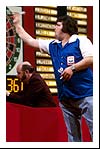
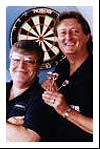
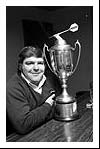
Previous Page Jocky Wilson: Pride of KirkcaldyIf someone were to write a list of the most popular of all Scottish sporting heroes, then surely near the top of the list would stand an unassuming Fifer with a less than athletic build, but who became one of the leading exponents of his sport and, with his wide grin, one of the most recognisable faces of sport in the 1980s. This man was darts legend, Jocky Wilson.Jocky was born in Kirkcaldy in 1951, and worked in a variety of manual jobs throughout his youth, including being a coal delivery man and also a miner at Kirkcaldy's Seafield pit. However, it was a spell of unemployment which was to prove the catalyst to Jocky achieving sporting greatness. While on the dole, Jocky entered the 1979 Butlin's Grand Master's competition, a competition he went on to win, claiming a grand prize of £500! This success was enough to convince the amiable Fifer to turn professional, and, within the space of a year, Wilson had entered the top ten of the professional ranks. Darts, like snooker, was really taking off at this point due to television coverage, and large crowds would watch the finals of the World Championships. The first of these was held in 1978, when Leighton Rees took the trophy to Wales with a triumph over legendary English player John Lowe. Also, like snooker, one player was beginning to dominate the sport. Much as the 1980s were the era of Steve Davis's dominance of the green baize, so Eric Bristow, the “Crafty Cockney” began to exert a stranglehold on darts world titles, beginning with this triumph in 1980 over the flamboyant Bobby George. It seemed that the two Englishmen, Bristow and Lowe, would exercise a duopoly on titles for the foreseeable future as Bristow retained the title in 1981, and Lowe steamrollered his way to the final the following year. Facing up to Lowe in the final was Jocky Wilson, the Scot having carved out a reputation as a formidable opponent in various lesser events, including winning the BBC Bullseye competition in 1980 and 1981. The 1982 final was a to be a repeat of that 1981 Bullseye final, as the Fifer ran out winner over Low by a score of 5-3, and Scotland had claimed her first darts World Championship.
For the next few years Wilson was there or thereabouts, a semi-finalist in both 1983 and 1984, but as the decade wore on it seemed his powers were on the wane. There was to be one more hurrah for brave Jocky however. In 1989, a series of stirring performances brought Wilson once again to the World Championship final, and brought him face to face again with his oft-times nemesis, Eric Bristow.This time however, the Scot was to run out triumphant, as, in a thrilling final, Wilson defeated the Londoner 6-4 to claim his second World Championship. In the early 1990s Wilson was one of a number of top players who seceded from darts' ruling body, founding the World Darts Council, in an attempt to move the game to a more professional footing. However, this dispute rumbled on throughout the rest of that decade, causing a schism in the world of darts which has never really been healed. In the mid 1990s Wilson retired back to his native Kirkcaldy, his name associated with a popular computer simulated darts game, and with an impressive manufacture of dart shafts. It is perhaps interesting to speculate just how much more Wilson could have achieved had he not played in the same era as Eric Bristow, probably the greatest darts player ever. How many more World Championships would have made their way to Fife?However, the end of Wilson's career should not be seen as the end of his influence on the game, as a new generation brought up watching his success are now competing at the top level. Les Wallace claimed the World Championship for Scotland in 1997, and now, younger players such as Gary Henderson, who grew up with Wilson as their hero, are now making their mark on the world stage. |