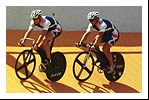
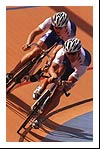
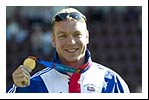
Previous Page Chris Hoy wins Olympic gold 2004The Edinburgh Commonwealth Games in 1986 were considered a sporting and financial disaster and the last time Scotland was allowed to stage a major sporting event. However, an unexpected bonus from the games came through the resurfacing of the velodrome in Meadowbank Stadium, which has amazingly made Scotland one of the top track cycling nations in the world.Both Craig McLean and Chris Hoy were introduced to the sport on the open air track in the east of Edinburgh and have now become two of the best track cyclists in the world today. Especially impressive considering the size of Scotland and its lack of cycling heritage. Chris Hoy, whose success at the one kilometre time trial leaves him with basically nothing left to win, is aware of the impact Meadowbank has had on his career. He said simply: "I don't see how any of us would have taken up the sport if the track hadn't been there. "It's not the ideal facility but if there had been no track I don't think there would have been any track success for Scottish riders." Apart from a place to practise their sport, many young athletes need a figure to which they can aspire and Chris Hoy was no different. For young Scottish footballers there are plenty of high-profile, home-based role models, but for aspiring cyclists, Scottish champions are few and far between. It was pretty fortunate then that Graeme Obree was at his peak when the young Chris Hoy first started cycling on the track. Hoy said: "I remember watching a TV documentary about the Chris Boardman and Graeme Obree rivalry and finding it fascinating. "There was Graeme Obree training in his backyard and Chris Boardman in a laboratory with technical back-up and psychological support. The whole thing just captured my imagination at that stage in my life." Hoy admits that he found Scotland's cycling world champion and world hour record breaker an inspirational figure. He said: "Graeme was just this amateur from a cycling backwater who had no backing or support, but off his own back he took on cycling legends like Eddy Merckx and beat their times against the clock." He added: "I was definitely inspired by him when I was just starting out." The admiration goes both ways. Graeme Obree said of Hoy: "What he has achieved is remarkable. He is Scotland's first Olympic champion in 24 years." Hoy first started cycling as a seven-year-old on his BMX bike and then moved onto mountain biking as a teenager. His interest in all things connected with bikes led him to join a local club, Dunedin Cycling Club, in his native Edinburgh, where he tried different types of cycling but realised he didn't have the physical build to make it as a road cyclist. However, his club would train on the velodrome in Meadowbank one night a week and it was through this Hoy found his niche.He said: "The Dunedin Cycling Club had their training down there on a Friday night and I thought I would give it a go. I quite liked it and put my name down to borrow a bike for the following season." From small beginnings he has developed into the world's fastest man over one kilometre and accumulated an Olympic gold and silver, three World Championship gold, two silver and two bronze, and a Commonwealth gold and bronze. However, it was last year's Olympic gold medal that has pride of place in Hoy's collection. In road cycling, an Olympic medal is rated far lower in a cyclist's palmares than the World Champion's rainbow jersey but track cyclists have different priorities.Hoy explains: "There is nothing in track cycling to compare with winning the Olympics. It is the be all and end all. "It was great to regain the World Championship but if I hadn't won the Olympic gold, the season would have been empty." Graeme Obree said: "At the Olympics, the previous three rides had all broken the world record so he had to go faster than he had ever gone to win the gold." In what will be remembered as one of the most exciting Olympic events of all time, the sea level world record for the one kilometre time trial was broken four times within 15 minutes. Hoy had to wait and watch as Shane Kelly, Stefan Nimke and then Arnaud Tournant all break the record, with Tournant becoming the first man to ride one kilometre in less than 61 seconds, before he got his opportunity. Through this Hoy had to make sure no negative thoughts broke his concentration. He recalls: "Any athlete who says they are 100 per cent confident all the time is not telling the truth but I did think I was in the best possible condition. "In a time trial you have no impact on the other competitors because you are racing against the clock but I thought if someone was going to beat me they would have to be riding extremely well." Hoy's next target is the 2006 Commonwealth Games in an attempt to retain the gold, won in the one kilometre time trial in Manchester in 2002, when he beat England's Olympic champion Jason Queally and became the first Scot to win a gold in cycling. Although many consider the Commonwealth Games a poor cousin to the Olympics, for Hoy they are important. He said: "It is the only time I get to ride for my country." And perhaps now living in Manchester makes the games even more important to the patriotic Scot. He added: "It is strange to compete against the guys who have been my team mates for the last three and a half years but it is the only competition where I can wear the blue Scotland jersey and hear Scotland the Brave, if I manage to win an event." Although Hoy has won everything his discipline has to offer, he has no intention of giving up the life of gruelling training and sacrifices that is the lot of the serious cyclist. "I still get enjoyment from training, in fact I love the whole process of being a track cyclist; the camaraderie with the other riders, travelling all over the world, the lifestyle and the satisfaction from winning. "As long as I enjoy the training I will keep cycling professionally." Written by: Gordon Cairns |