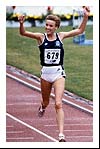
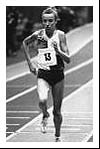
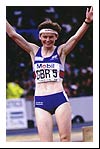
Previous Page Liz McColgan and Yvonne MurrayIf you were to search for a role model to put before aspirant young athletes, you would do well to find a better example than Liz McColgan.She rose from a council estate in Dundee and, against all the odds, found widespread international recognition for her success in the 1988 Seoul Olympics. Her career accomplishments were achieved not only through natural talent but from sheer grit and determination, the classic embodiment of Scottish sporting triumph. Born Elizabeth Lynch in Dundee, she showed precocious talent from an early age and, as a junior member of the Hawkhill Harriers Club, won the Dundee Schools Cross Country Championship in 1976. This was the first step on the road towards a glittering career which spanned over 15 years and took her to every corner of the globe. Lynch first came to the public's attention in 1986 when she took gold in the 10,000m at the Commonwealth Games in Edinburgh. Coupled with making a name for herself on the world stage, she also helped prove that not only was Scotland capable of hosting such a games, but the country was producing talented athletes who could compete among the very best. She married Northern Irish steeplechaser Peter McColgan in 1987 and assumed what was to become one of the most famous surnames in sport. Undoubtedly McColgan's finest hour came at the 1988 Olympics in Seoul. She was listed to compete in the 10,000m event with a field crammed with top quality competitors, including Ingrid Kristiansen who had dominated the 10,000m for the previous two years and was the clear favourite to win again in Seoul.Surprisingly Kristiansen retired early in the race with a foot injury, leaving McColgan and Olga Bondarenko to fight it out for victory. The Scot led until the final stages, but was outsprinted by Bondarenko, who subsequently broke the Olympic record. McColgan claimed silver for Great Britain. The Dundonian then took a year off to have her first child, Eilish. This left a gap to be filled and her contemporary Yvonne Murray duly obliged. Murray had taken bronze in the 3,000m at Edinburgh in '86 and silver in the same distance at the Euro Championships the same year.She was also among the medals in 1988 at the Seoul Olympics, claiming bronze at the 3000m distance, finishing less than three seconds behind Tatyana Samolenko of the former USSR. Murray and McColgan had helped give British athletics, and especially the women's sphere, new credibility and garnered respect from the public, who regarded them as the two 'queens of the track'. "I never saw Liz give anything less than 100% in any race she competed in," said Brendan Foster, the former 10,000m Olympic bronze medallist. McColgan justified his claims by coming back from having her year-long maternity break to win the 10,000m at the 1991 World Championships in Tokyo and created an impressive double with the New York City Marathon that same year. Records kept tumbling as she became the first British woman to go under 31 minutes for 10,000m in a race in Norway. The following year provided no respite for McColgan, whose relentless pursuit of glory led her to gold in the inaugural World Half-Marathon in Newcastle, setting a new world record for half-marathon of 67minutes 11 seconds. She also tasted victory in the Tokyo Marathon and set the British Indoor 5000m record of 15 minutes and 3 seconds, a time that still stands to this day. On top of that already memorable year, she finished 5th in the 10,000m final at the Barcelona Olympic Games, and was awarded an MBE for services to sport. Five London Marathons, another Olympic Games and numerous other world-class events later Liz McColgan retired from top-class athletics in 2001. Yet her legacy is still felt throughout the athletics world. That same year her protégé Collette Fagen, based in Coatbridge, and with McColgan as her coach, gained European Junior bronze at 3000m. Liz McColgan Health Clubs are springing up all over the country and she is now coaching a group of 20 youngsters age 9-16 at local club Dundee Hawkhill Harriers.She has maintained a high profile in Scottish sport and is now the Chairperson of Scottish Athletics, the body responsible for developing activities in Scotland and was inducted into the Scottish Sports Hall of Fame in 2004. Written by: Robert Thomson |