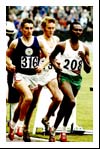
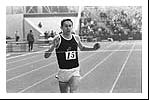
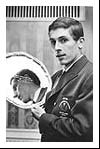
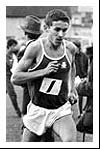
Previous Page Ian StewartIan Stewart is widely regarded as one of Scotland and Birchfield Harriers' greatest runners.He was born in Handsworth, Birmingham on 15 January 1949, the third of six children of John and Mary Stewart. After the two eldest children (Carol and Peter) were born in Scotland, the family relocated from Musselburgh to Mary's native Birmingham in 1948. To many particularly of a certain age in Scotland, Ian Stewart is best remembered for his magnificent victory in the 5,000 metres at the 1970 Commonwealth Games in Edinburgh. In front of his "home" crowd at Meadowbank Stadium, the 21-year-old defeated Ian McCafferty and two legendary world distance stars, Kipchoge Keino and Ron Clarke in a European record time of 13:22:8. However, this was only one of many international successes in a remarkable athletics career.
After initially joining Small Heath Harriers, Ian moved to Birchfield Harriers where his older brother Peter was already a member. Geoff Warr coached the brothers and Ian's initial notable successes were achieved over the country. He became Midland Youth champion in 1966 and was runner up in the Youths National Cross Country at Norwich in 1967 before becoming Midland and National champion as a first year Junior in 1968. After reading an article about the American miler Jim Ryan, Stewart "jacked up his weekly mileage" to include a 16 miles run on Sunday mornings followed in the afternoon by ten miles fartlek in two neighbouring Perry Barr parks. The teenager's enterprise and single-mindedness soon paid dividends. In 1969 a couple of months after his 20th birthday, the Birmingham gun tester won the first of several international titles over 3,000m at the European Indoor Championships in Belgrade in a UK Indoor record time of 7 mins 55.4 secs. Three months later on 11 June 1969 at Reading, Ian and his older brother Peter became the first brothers in the world to break the four minutes barrier for the one-mile in a race won by fellow Scotsman, Ian McCafferty. Ian Stewart clocked 3 mins 57.3 secs, four-tenths of a second ahead of Peter. In early August, Stewart won his first AAA outdoor title over 5,000 metres in 13:39:8.
The Stag defeated the specialist milers John Boulter and the tall marine Jim Douglas to create a British record of 3m 39.0 secs in a three a side Great Britain versus France match on 1 September at the White City. Eighteen days later Ian displayed maturity beyond his years to complete a European double, winning the 5,000m in Athens. After finding himself in the lead early on, he stepped aside and invited the rest of the field to take their share of the work before unleashing what was to become his trademark long surge for home. He crossed the finishing line alone in 13m 44.8 secs. In June 1970 in what was to subsequently prove to be the clash of the Commonwealth champions, Ian Stewart ran away from Lachie Stewart (no relation) to win the Scottish 5,000m title in 13:47:8 whilst Peter out sprinted Ian McCafferty over 1,500m for an unusual family double on the same afternoon. A week later there was no quarter given or asked for when the brothers went head to head in the Emsley Carr Mile at the British Games at Meadowbank, which the caption writers dubbed "Oh brother." Whilst both were given the same time of 3m 57.4 the verdict went to Ian, although Peter won the prestigious Emsley Carr Mile on another two occasions.The final individual event before the Closing Ceremony of the Commonwealth Games at Edinburgh's Meadowbank Stadium was the eagerly anticipated 5,000 metres Final in the late afternoon of 25 July 1970. The strong pre-race favourite was the defending champion from Kenya, Kip Keino who earlier in the week had won the 1,500m. However, many athletics enthusiasts were willing the hugely popular Australian runner Ron Clarke to lift the title to accompany his many world records. Englishman Dick Taylor, who had created a UK record on the same track six weeks earlier, threw down the gauntlet after an indecisive 71 seconds opening lap. The red-haired Coventry Godiva Harrier increased the tempo considerably and led the field for more than two miles. To the delight of the capacity crowd, Ian McCafferty hit the front with 800m remaining and it seemed likely that the host nation could win two medals. Their optimism was tempered by the continuing, imposing presence of Olympic champion Kipchoge Keino. Stewart made a decisive move at the start of the home straight with 450 metres to run. Although McCafferty moved close to him, he was fiercely determined that no-one was going to overtake him on the home straight. With his right arm aloft, Stewart crossed the line the Commonwealth champion to add to his European titles in a new European, UK and Scottish National record time of 13m 22.8. Ian McCafferty took the silver medal in a Scottish Native record of 13m 23.4 with the illustrious Keino in the bronze medal position. Recalling his triumph 35 years later, Ian said, "I ran easily to qualify for the Final on Thursday. I had beaten the world record holder Ron Clarke by 11 seconds in Stockholm and I felt that the final would be between Keino and myself. I hit the front at the top of the home straight with one lap remaining and went for home. "The crowd was extremely supportive on the last lap and when I finished I was told that I had run the second fastest time in athletics history. I didn't know for certain that it was Ian McCafferty who was second but we both got a great reception when we did a lap of honour and later on when Princess Anne presented our medals." Although 1971 began promisingly with Stewart defeating Dave Bedford to win the AAA Indoor 3,000m title at RAF Cosford in a UK all-comers record of 7m 50.0 secs, a debilitating abscess wiped out his summer season. Although he brought home a bronze medal from the 1972 Olympic Games in Munich, Stewart was deeply disappointed at both his performance and how the final had been run. Whilst most pundits were anticipating the first 3K to be covered in a time close to eight minutes, in the event it was in fact 20 seconds slower. Finland's Lasse Viren who had earlier won the 10,000m title took control and completed the Olympic double in 13:26:4. Stewart finished strongly to snatch the bronze medal on the line from the American Steve Prefontaine in 13:27:6 but he knew only too well that it was an opportunity lost to achieve his ambition to become Olympic champion. The athlete who coined the phrase "first is first and second is nowhere" was tempted to "throw his medal over the grandstand."A disappointing fifth place over 5,000m and sixth at 10,000m in the Commonwealth Games in New Zealand in early 1974, prompted him to try his hand at cycle road racing that summer. Having "recharged his battery" the Scot returned to athletics with a bang. In March 1975 Ian made athletics history when in the space of one week, he not only won his second European Indoor 3,000m title in the Polish city of Katowice but also followed this by defeating a global who's who of endurance running including Lasse Viren to win the World Cross Country title at Rabat in Morocco. Thirty years later, he remains Great Britain's last male winner in this World championship race. His next objective was to step up in distance to the 10,000m for the 1976 Montreal Olympics and all his training was geared to that goal. In what was one of the hottest ever-English summers, "the tough of the track" was forced to drop out of the Olympic Games 10,000m trial at the Crystal Palace because of a blister the size of an egg on the ball of his foot. Although in excruciating pain and with his foot heavily strapped up, Stewart proved his fitness by completing 10,000m in Finland four days later in a world-class time just outside 28 minutes. Although the other contender Bernie Ford declined the opportunity to compete in a run off with Stewart, the Selectors perversely selected Stewart for the 5,000m and Ford for the 10,000m. After leading the 5,000m final at the bell, Stewart placed seventh in a season's best time of 13:27:8 in a race in which Lasse Viren achieved athletics immortality with a fourth Olympic gold medal. On 8 May 1977 Stewart produced arguably his most remarkable athletics performance when he got away from the field in the first mile to complete the Michelin ten miles Road race in Staffordshire in a time of 45 minutes 13 seconds. Because the time was so unusually fast, the race organisers remeasured the course and found it to be the correct distance. World Cup Marathon winner Richard Nerurkar recorded the next fastest time by a Briton of 46:02 sixteen years later in October 1993. In June 1977 Ian again ran solo to win the inaugural UK Championship 10,000m in 27:51:3 at Cwmbran and recorded what was to prove to be a career best time of 27:43 at the end-of-season Coke Meeting at Crystal Palace. In 1978 Stewart was runner-up in the English National Cross Country Championship at Leeds in what was his last serious tilt as a competitor on the national stage, although he subsequently ran as a veteran. That summer his sister Mary who had become an Olympian two years earlier, was crowned Commonwealth 1,500m champion in a Games record time in Edmonton. For the past eight years Ian Stewart has been employed by Fast Track, the commercial wing of UK Athletics as Meeting Director to negotiate and assemble the best athletes in the world to compete at all the televised international athletics meetings staged in this country. Like many great champions, it was said in some quarters that Ian Stewart could be "mean, moody and magnificent." The man himself attributes his success to a strong work ethic and a positive mental attitude. "I always believed that if I was in shape I could beat any one in the world. It all came down to how close I could get to my best."Stewart feels deeply honoured to have been included in the first tranche of sportsmen and women to be inducted into the Scottish Sporting Hall Of Fame. He recalled, "It was a great initiative and I greatly enjoyed a most memorable occasion." Retaining his slim muscular build, Stewart has lived in Worcestershire for about five years. He enjoys walking his two Scottish deerhounds (Hector and Archie) for miles across the fields and bridle paths. Three times a week his brother Peter, who is also a former European Indoor 3,000m champion, joins Ian and "his lads" for a run in the country at a more leisurely pace than at the height of their powers in the 60's and 70's. Written by: Tom McCook |