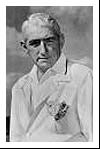
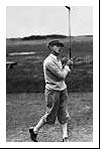
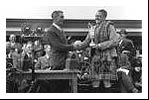
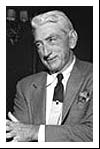
Previous Page Tommy ArmourThe 1931 Open Championship was the first to be held at Carnoustie, just north of Dundee on Scotland's east coast. The assembled field was one of the strongest in the tournament's history with names that were to become part of golf's folklore; Henry Cotton, MacDonald Smith, Gene Sarazen and the eventual winner, exiled Scot, Tommy Armour.Born in Edinburgh in 1895, Armour emigrated to the USA in 1925 to enhance his golf career. The move was successful and before Armour arrived at Carnoustie, he had already won the 1927 US Open in a play-off with Harry Cooper, and the 1930 US PGA title. When the tournament got under way Armour made a reasonable start, opening with a 73, which left him one shot behind the joint first-day leaders, Johnny Farrell, Henry Cotton and William Twine. Cotton was still in front after the second day, a 75 giving him a total of 147. He was joined at the top of the leader-board by Argentinian Jose Jurado. Tommy Armour was third on 148, after equalling Cotton's score of 75. When Armour shot a disappointing 77 in the third round, his best chance looked to have gone. True, Henry Cotton had fared worse, returning a 79 which put him right out of contention, but Jurado had seized the initiative with a 73, to give him a total of 220 and a three-stroke advantage over the field. MacDonald Smith and Arthur Havers were his nearest rivals; Reg Whitcombe and Johnny Farrell were a shot further back. Alongside Armour on 225 were Percy Alliss and Gene Sarazen, both of whom were capable of making a move in the final round and for a long time Alliss threatened to do just that, until a poor finish saw him take 11 shots over the closing two holes for a score of 73 and a total of 298.Armour also found himself in a good position as he entered the latter stages of his round, but unlike Alliss, he kept his game together and was able to equal the course record with a 71. His four-round total of 296 was the new target. With none of the other contenders making any impression, Jose Jurado appeared to have the tournament in his grasp at the turn: 36 shots to cover the front nine meant that he could afford to play the back nine in 39 strokes and still take the honours.With the pressure mounting, mistakes began to creep into the Argentinian's game and he started to drop shots. By the time he reached the 17th, his cushion had all but gone and he now required to finish 5, 5, just to tie with the "Silver Scot", Armour. Jurado picked the wrong time to hit his worst drive of the week, putting his ball into the burn barely 130 yards off the tee and scrambled his way to a six. Needing a four to finish level with Armour, he missed a ten-foot putt that would have forced the play-off allowing the naturalised American to lift his third Major title. Armour's achievement was all the more remarkable when you realise that he was handicapped by being partially blind. During the First World War, he had been badly injured by a mustard gas attack. Not only did he require a metal plate to be inserted in his head and arm, but he lost his sight totally. After a period of convalescence, he did regain vision in his right eye but remained blind in his left. There is an amusing anecdote told regarding Armour's success. He was notorious for slow play and for taking his time as he lined up his shots. On one occasion his caddie advised aiming for a distant pole, which transpired to be the mast of a ship in the North Sea. By the time Armour hit a perfectly executed strike, the ship had sailed far enough to ensure the shot buried itself in a greenside bunker. It didn't stop him lifting the Claret Jug!Written by: Dave Low |