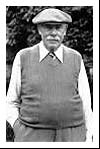
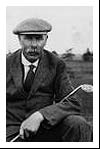
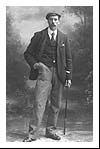
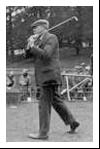
Previous Page James BraidOne of three golfers who made up the "Great Triumvirate" in the early years of the 20th century (Harry Vardon and JH Taylor being the other two), James Braid captured five British Open titles in ten years between 1901 and 1910. The trio dominated golf; claiming the title no fewer than 16 times between 1894 and the outbreak of the First World War in 1914.A keen golfer from a young age, Braid received little encouragement to play the game from his father who believed it was a waste of time! However, the determined Braid continued to play and caddy in Elie before he moved to St Andrews and then Edinburgh to work as a joiner and then later to London where he became a club maker. His standard of play impressed and he was offered the post of professional at Romford Golf Club in 1895. James Braid was now firmly established as a leading professional golfer, but unlike his contemporaries, Braid rarely competed outside the United Kingdom. A fear of the sea made him an unwilling traveller and although he ventured across the channel to France on a few occasions, he never went to the United States. Instead he concentrated on domestic tournaments and was rewarded when he won the Open for the first time at Muirfield in 1901. After coming close to success in the next three years he won again in 1905 at St Andrews, at Muirfield in 1906 and at the original home of the Open, Prestwick, in 1908. Ironically for a man who lived and worked in England, Braid's successes had all come in Scotland, so it was no surprise that he was one of the favourites for the 1910 tournament at St Andrews, just a few miles from his birthplace, down the Fife coast at Earlsferry.As Braid set out on his opening round conditions were calm, but as so often happens at a links venue, the weather changed rapidly and by the time Braid reached the 13th with greens flooding, the committee had taken the decision to abandon play and begin the tournament again the following morning. Braid was taking no chances and decided to continue his round, in case he had been mis-informed! When the tournament restarted, Braid returned a first round 76, ironically the same score as he had recorded during the previous day's downpour, and sat three shots behind the leader, George Duncan.A second-round 73 kept him in touch with the leaders who now included exiled Scot Willie Smith, the US Open Champion of 1899. His score of 71 was the best of the second day. Duncan regained his advantage with a third round 71, but as Smith dropped back having shot an 80, the steady Braid maintained his position with a 74. Sandy Herd, the 1902 winner, moved into contention during the final round recording a total of 303, but Smith continued his slide with a second successive score of 80. Duncan, meanwhile, lost his touch around the greens and faded from the picture with a closing 83. That left Braid with the chance to seal an unprecedented fifth win, which he duly did, closing with a 76. In doing so he set a new record for the lowest ever total around the Old Course during an Open Championship of 299. Throughout his adult life Braid suffered from eyesight problems following an accident with lime whilst working as a joiner. As he grew older the condition worsened and it affected his career. He continued to play to a high level but never again came close to winning a title.Braid's name was now becoming synonymous with golf course design and he became one of the leading architects in the world with the Kings and Queens courses at Gleneagles and Blairgowrie's Rosemount amongst his most famous lay-outs. He also was responsible for making alterations to previously established courses such as Troon in Ayrshire and Ballybunion in Ireland. He remained involved in golf as professional at Walton Heath in Surrey until his death at the age of 80 in 1950. Written by: Dave Low |