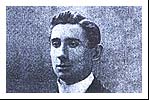
Previous Page Arthur RobertsonNearly a century after he achieved the distinction of being Birchfield Harriers' first Olympic Gold medallist, Arthur James Robertson was posthumously inducted into the Scottish Sporting Hall of Fame in November 2004. Robertson becomes the second Birchfield Harrier to receive this honour, following the 1975 World Cross Country Champion Ian Stewart.The first of only six Scots to win Olympic athletics gold, Robertson is the only one apart from the Chariots Of Fire hero Eric Liddell to set a world record in an Olympic track and field event. The four other Scottish athletes in that exclusive club are Wyndham Halswelle, also in 1908, Henry Maitland Macintosh 1912, Robert Lindsay 1920 and Allan Wells in the 1980 Moscow Olympiad. Sadly neither Halswelle nor McIntosh survived the Great War and Liddell died of a brain haemorrhage in a Japanese Internment Camp in February 1945. Robertson, the son of a Scottish Doctor – (John Arthur Robertson, who was described as "a golfer and curler of Fife") was born in Sheffield on 19 April 1879. Although for most of his life his home was in Peterborough, AJR was educated initially at Glasgow's Kelvinside Academy and then the King's School, Peterborough. His first recorded athletics achievement was winning the One Mile race in a record time whilst a pupil at the Kings School. It was not until he was 25 years of age in 1905 that Arthur began to compete seriously as an athlete after being injured cycle racing. In 1906, Arthur transferred from Peterborough AC to join the successful Birmingham club, Birchfield Harriers whose emblem is a stag with the motto "Fleet and Free." (It is for this reason Birchfield Harriers are frequently referred to as the Stags.) The following year he won the Midland Counties Ten Miles title. The same season this versatile and seemingly indefatigable runner was runner-up in the two miles steeplechase, fourth in both the one and ten miles races and fifth over the four miles distance at the AAA Championships! Although he was only with the Perry Barr club for three years, he achieved considerable successes in that time carrying all before him in the Olympic season of 1908. When he was crowned English National Cross Country Champion at Newbury that spring, the magazine Sport and Play reported the conclusion as: "A stampede of people from the stand to the rails gave warning of the leaders' approach. It was seen that Robertson was out in front with a commanding lead and we all knew that his speed would get him home winner of the National Championship. Undistressed he came home, with his hands down - no side, no gallery play - a modest champion of the first order. Proud of his win, proud of his club."
Robertson went on to win the International Championship in Paris when a dominant England team impressively packed their scoring six runners into the first seven finishers. He was runner-up in the 1908 AAA four miles championship, won two medals at the 1908 Olympics at London's White City Stadium, Gold in the three-miles team race, which Britain won ahead of the US and France, and silver in the 3,200m steeplechase. This silver medal remains the only occasion that a Scottish athlete has won a medal in a steeplechase event at any international championship to date. He also placed fifth in the five miles race. His brother DC was a member of the GB cycling team at the same Olympics. Robertson also created several Scottish endurance records, which remained intact until after both World Wars. He set a three-miles record at Windsor (14min 27.2sec) in late July, which survived for three decades until 1949. A few days later on 1 August 1908, at the Rangers Sports at Ibrox Stadium in Glasgow, he sliced 21 seconds from the Scottish four-mile record. His 19 mins 45:2 secs performance stood for 45 long years as the Scottish record. At the end of August the intrepid Robertson crossed the North Sea by ship for a racing tour of Scandinavia. Running almost every day, he won several races. His greatest triumph took place on 13 September 1908 when on Stockholm's cycle track; A.J. stopped the clock in 15:01.2 to defeat the World 5000 metres record-holder John Svanberg in front of his Swedish fans. This performance not only took more than a dozen seconds from Svanberg's previous world's best time but also would have been fast enough to secure the Olympic 5,000m bronze medal in Paris 16 years later in 1924. Just 24 hours later, on a banked concrete track, Robertson missed the world one-hour best by 228 yards and was within 83 yards of the legendary Walter George's UK record. He covered 11 miles 849 yards, setting Scottish records en route at six miles and 10,000m (30:26.0 and 31:30.4). Unsurprisingly in view of the intensity of his racing schedule, the Scot could hardly walk for some time afterwards because of excruciating bruising and soreness to his ankles and feet. Robertson led Birchfield Harriers to their tenth National team title and was runner-up in individual race at the 1909 English National Cross Country Championships on Haydock Park Racecourse. Arthur retired from athletics in 1909. He won two more silver medals in the same afternoon in the one and four miles events in his last season but missed out once again on an elusive AAA title. He returning to cycling at the age of 30 after a mercurially short athletics career in which he scaled the heights of national and international success. He later became a Director of Peterborough Town Football Club after playing for the club in a varied sporting career. Arthur and his brother ran a sports shop in Peterborough for many years. Written by: Tom McCook |