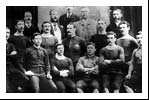
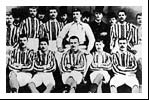
Previous Page Renton Crowned World ChampionsFootball's first World Championship trophy is an unimpressive piece of work. It's around a foot high and made of inexpensive pewter. The trophy's permanent home as one would expect is somewhat grander - a museum dedicted to the game in one of football's sporting cathedrals.But what's it doing in the Scottish Football Museum at Hampden Park? The trophy was won by the Dunbartonshire village team of Renton in 1888 in the heydey of the amateur game in Scotland. Renton were one of several in the Dumbarton area - others include the Vale of Leven and Dumbarton. Sandy McBain of the Scottish Football Museum outlines one reason for the popularity of football in the area. "Queens Park did an exhibition game in the area and perhaps the locals decided it was a better game than rugby. They would also have seen that football was a simpler game; whatever the reason football was extremely popular in Dunbartonshire." Renton, Dumbarton and the Vale of Leven were all early winners of the Scottish Cup. Indeed it was Renton's six-one thrashing of Cambuslang in the cup final of 1888 that started them on the road to becoming the first world champions. According to the myth that now surrounds the story, Renton were challenged to a match by the English FA Cup winners West Bromwich Albion. Whatever the circumstances, a game was subsequently arranged to determine who were the "Champions of the United Kingdom and the World". The venue was Second Hampden at Cathkin. The date: the 19 May 1888, although the match nearly didn't take place at all. Newspapers of the time report that the game was played in the foulest of conditions. A thunder storm had wreaked havoc in Glasgow, claiming the lives of four people. Perhaps unsurprisngly West Brom wanted the game postponed - but the hardy Rentonians insisted the game go ahead. Around six thousand spectators watched the Dark Blues beat their challengers by four goals to one.
Two of Renton's goals were scored by the McCall brothers, Jamie and Archie - both Scottish internationals. Indeed Renton's dominance of the Scottish game in 1888 is highlighted by the fact that eight of the
team represented Scotland that year. Renton also beat both Sunderland and Preston in 1888. So perhaps they were justified in describing themselves as champions of the United Kingdom - with apologies to Wales and Ireland (pre-partition of course). But champions of the world?Historian and broadcaster Bob Cramspey isn't convinced: "The claim has been vastly overplayed. It started off as a bit of a joke. After all, if you don't play anyone else how can you be champions of the world." But even at Renton's moment of triumph, the seeds of Renton's demise were being sown. Bob Cramspey explains: "Market forces entered football. Professionalism entered the sport and players began to gravitate towards metropolitan teams both in Scotland and down south. "Even before the advent of professionalism, players could be lured away with the promise of well-paid jobs arranged by the bigger clubs. "There are even stories around that English Scouts would be giving a good soaking in the local river if they were seen sniffing around a match in Scotland." In the same year as Renton were crowned "World Champions" one of the Scottish game's biggest clubs was born in the East End of Glasgow. And soon two of Renton's star players were on their way to Celtic, as both Neil McCallum and James Kelly swapped the dark blue for the green and white. Renton soldiered on, however. They were one of the founder members of the football league in 1890, although they were expelled after just a handful of games. That was because they'd played a friendly match against a "professional" team, the Edinburgh Saints. Renton were re-admitted the following season and continued as a Scottish Football League side until 1898 when they resigned from the league. Twenty four years later they folded completely. Renton's place in Scottish football's history is but a brief chapter. Their story is one of a village team triumphant in an age of amateurism, yet unable to survive long after the birth of professionalism.
The club's legacy - part myth, part historical fact. But worthy of a place in the Scottish Football Museum. Written by: David Currie |