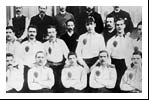
Previous Page The Founding of Celtic Football Club 1888The reasons behind the founding of Celtic Football Club were largely connected to the desperate conditions in which the working-class Irish immigrant community in Glasgow's east end found itself in during the late 1880's. Severely overcrowded, poverty-stricken, starved of food, as well as employment, and in poor quality housing, the area certainly did the not have its problems to seek. To add to these social problems, Irish immigrant numbers were still steadily increasing, with many of their numbers competing with those who were already in Glasgow, as well as the indigenous Scots population, for what little paid work was available at the time. Relationships became strained and tension, indeed often hostility, between Irish and Scots was an inevitable result of this.Into this background came the main player in the founding of the club; born as Andrew Kerins in Ballymote, County Sligo, Brother Walfrid was a Marist priest and Headmaster of Sacred Heart School. A tireless community worker for the deprived Catholic residents of Glasgow's east end, Brother Walfrid saw the new football club purely as a fundraising enterprise. The name of the club, Celtic, was Walfrid's own suggestion and was intended to reflect both Celtic's Irish and Scottish roots. Although the club's crest proudly bears the date 1888, football historians are generally in agreement that the club was formally constituted, and therefore actually founded, in 1887, on November 6th to be precise, in St Mary's Church Hall in East Rose Street (now Forbes Street), in the Calton district of the city. It would be over six months later before the newly-constituted Celtic club played its first ever match, on May 28th 1888 which resulted in a 5-2 win over Rangers, in what was called a 'friendly match'. The match was played at the first Celtic Park, a hundred yards or so to the northeast of the present ground and close to the present day headquarters of another great Scottish institution: Barr's Irn Bru. Celtic paid an annual rent of £50 to their landlords for the use of their first ground, which they rented until the club moved to the site of the present ground in 1892. Neil McCallum scored the club's first ever goal in that victory over the Ibrox club, in a game that was watched by a crowd estimated at around 5,000, comparatively small when one considers the 100,000 plus crowds that would watch future clashes between these clubs. Then again, of course, none of that crowd could possibly have been aware that they were watching the start of what would in the future develop into one of the world's great footballing rivalries.Success wasn't long in coming for Celtic. In their first full season of competition they reached the final of the Scottish Cup, only to lose 2-1 to Third Lanark. However they did lift some silverware in this initial season, winning the North-Eastern Cup, which despite its grand name was merely a local competition, with a convincing 6-1 win over Cowlairs. National success soon followed. Celtic won the Scottish Cup in 1892, with a 5-2 win over Queens Park at Ibrox. The following year came Celtic's first Scottish League championship success. Between 1892 and the outbreak of World War One, Celtic claimed eleven league titles, including six titles in a row between 1905 and 1910, and nine victories in the Scottish Cup. The driving force behind Celtic in those early years was Willie Maley, a former player who became the club's first secretary and manager. Maley adopted a successful youth policy, signing great players like Jimmy Quinn and Patsy Gallacher from the ranks of Junior football, culminating in another four successive League Championships during the war years. Written by: Paul MacDonald |