

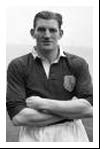
Despite that, the selectors don't appear to have been operating with a great degree of consistency. Eighteen players were used in the three games against Northern Ireland, Wales and England, and only five played in every tie. Incredibly, some of the selectors had never seen Willie Moir of Bolton Wanderers play. In season 1948/49, Moir was top scorer in the English First Division, so presumably this was enough to convince the committee that he could handle such an important game for his country. In addition to Moir, the other debutants were Ian McColl of Rangers and Willie Bauld of Hearts.
The teams at Hampden that day were as follows:
Scotland: Cowan (Morton), Young, Cox, McColl and Woodburn (all Rangers), Forbes (Arsenal), Waddell (Rangers), Moir (Bolton), Bauld (Hearts), Steel (Derby), Liddell (Liverpool)
England: Williams (Wolves), Ramsey (Tottenham), Aston (Manchester United), Wright (Wolves), Franklin (Stoke), Dickinson (Portsmouth), Finney (Preston North End), Mannion (Middlesbrough), Mortensen (Blackpool), Bentley (Chelsea), Langton (Bolton).
The first half at Hampden ended goalless, but after 63 minutes Chelsea's Roy Bentley shot from inside the box after getting clear of Woodburn. Cowan got a hand on it but it was too powerful and ended up in the net.
Scotland had to find a goal from somewhere if they were to reach the World Cup. Bauld came closest, hitting the bar, and with minutes remaining Willie Waddell smacked the ball inches over the bar. Scotland simply could not conjure up a goal and when English referee R Leafe blew for the final whistle, England were the champions. The inquest and begging began.
 |  |
© SCRAN | |
|
We have heard it many times since: the World Cup was over for another four years at least.
There are three interesting footnotes to this sorry tale. First, England's trip to Brazil ended in embarrassment, for they lost 1-0 to the United States and were beaten by Spain to make a premature exit from the tournament. Before the England game the US manager Bill Jeffrey had said, “We ain't got a chance against your boys,” yet a headed goal by Gaetjens gave the States their astonishing victory.
There is a certain irony here: Jeffrey was a Scot who had emigrated to America, played for a works team against Penn State College and got his chance in football management when he was later asked if he fancied coaching that same college side.
Secondly, FIFA managed to get only 13 countries to come to Brazil, instead of the 16 it sought. France had been edged out by Yugoslavia in their qualifying group, but were then invited to take the place of Turkey. They declined because of the distance they would have to travel. Austria pulled out because they said their team was too young, and India qualified but refused to come. Argentina had fallen out with the Brazilian FA and so they boycotted the tournament.
Thirdly, for the 1954 World Cup, the qualifying arrangements were the same for Scotland, England, Northern Ireland and Wales. In '54 Scotland finished runners-up to England, yet they went to the World Cup. Perhaps Switzerland was a more preferable destination for the SFA executive committee than Brazil had seemed.
It is hard to fathom the stance of the executive committee. Perhaps it was arrogance or pride; it may even have been over-confidence in the abilities of its players; or possibly it was a lack of vision at how football was developing. Then again, the main issue may have been one of financing the national team's trip to South America.
However, we can say with certainty that by missing out on Brazil 1950, Scotland lost the chance to gain international experience, something that would haunt them in the early '50s as they began to lose to continental sides that for decades they had assumed they could beat.




