
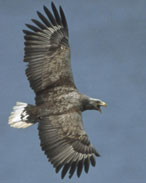
Sea eagles are large, broad-winged birds with a wedge-shaped tail. Their plumage is mainly brown, but the adult has a pale head and a distinctive white tail. The head and beak are larger than that of the golden eagle. The eyes, beak and talons are bright yellow.
Nest building begins in November with preferred tree nests being typically 2-3m across and 2-4m high. Cliff nests are smaller, about 2m high and 1-1.5m across. Birds pair for life and both will gather sticks and branches for the nest. A favoured site may be used for years or even centuries. Everything from driftwood to fishing floats have been found making up these massive constructions.
Persecuted to extinction in the 19th Century, the sea eagle was reintroduced to the island of Rum in the Inner Hebrides in 1975 and since then several breeding pairs have been successful in rearing young. Featuring on the red list of UK birds of conservation concern, the sea eagle is still at risk from persecution and illegally placed poisons intended for foxes and crows, while its nests are at risk from egg collectors.
The white-tailed sea eagle is the fourth-largest eagle in the world and is considered a close relative of the American bald eagle.
Where to see them
Sea eagles are commonly found in the far west coast of Scotland and the Inner Hebrides. The location of nesting sites are a closely guarded secret due to their conservation status.
Page first published on Monday 7th April 2008
Page last updated on Friday 17th October 2008


Post Your Comment