
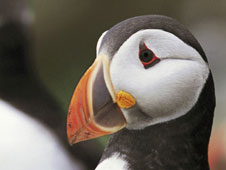
One of the most unmistakable seabirds in the UK, puffins spend most of the year at sea, only returning to land to breed.
The puffn is a striking bird with a black back and white chest, black head with large pale cheeks and a tall, flattened, brightly-coloured bill. Its almost comical appearance is heightened by red and black eye-markings and bright orange legs. The puffin's latin name 'fratercula arctica', meaning 'little brother', probably refers to its black and white body's resemblance to monastic gowns.
It is common at colonies to see large numbers of puffins flying in wide circles. These wheels are thought to be a way of swamping predators, such as black-backed gulls, and reducing the risks for individual puffins. With half of the UK population located at only a few sites the puffin is an amber list species in the UK list for birds of conservation concern.
Where to see them
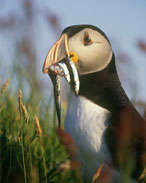
Best looked for at a breeding colony. Try the Isle of May or Inchcolm (off the Fife coast); Staffa and the Treshnish Isles off Mull, Shetland and Orkney, as well as the Farne Islands on England's north west coast off Northumberland. The largest puffin colonies are on the remote archipelagoes of St. Kilda and the Shiants.
When to see them
Adults arrive back at the breeding colony in March and April and leave again in mid-August. Some remain in the North Sea at winter, other move further south to the Bay of Biscay.
Page first published on Monday 7th April 2008
Page last updated on Friday 17th October 2008


Post Your Comment