
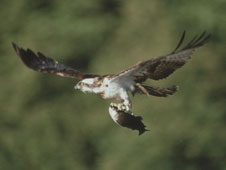
With its white belly and black wingtips and wrist patches, the osprey is easily recognisable.
Having become extinct as a breeding bird in Scotland in 1916, the osprey re-colonised naturally in 1954 with around 150 pairs now breeding here.
Unlike most UK birds of prey, ospreys have adapted exclusively to a diet of fish. They have been hunted by fish farmers who see them as a threat to their stock, and this, along with the negative effects of pesticides and disturbances, has led to ospreys being placed on the amber list of UK birds under threat.
Where to see them
The osprey's main UK stronghold is in Scotland; nest sites with public viewing facilities can be found at Loch Garten, Speyside, and Loch of the Lowes, Perth. Further south there is a public viewpoint at Bassenthwaite in Cumbria. Ospreys can also be seen near almost any large body of freshwater during spring and autumn migration.
When to see them
The birds spend the winter months in Africa, returning in late March and April. The male precedes the female, performing sky dances near the eyrie which escalate when the female returns. They leave for warmer climes again in August and September.
Page first published on Monday 7th April 2008
Page last updated on Friday 17th October 2008


Post Your Comment