Scotland's Wildlife: Gannet

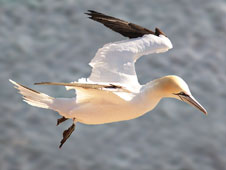
Gannet (c)

Adult gannets are the largest indigenous seabird in the northern hemisphere with a wingspan reaching up to 2m. Their snow white colouring and their long neck, long pointed beak, tail and black-tipped wings make them very distinctive.

At sea they often travel in small groups, flapping and then gliding low over the water. They feed by flying high and circling before plunging into the deep. Diving from 30m they can reach speeds of 100km/h.

St. Kilda hosts approximately 20% of the world's gannet population. The Bass Rock in the Firth of Forth is home to around 150,000 of the birds.
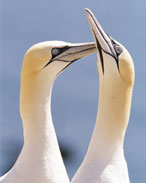
Gannet chick (c) RSPB images

Breeding in significant numbers at only a few localities, gannets are placed in the amber zone of the UK list of conservation importance for bird species. However, young gannets - or guga in Gaelic - are considered a delicacy on the Isle of Lewis. Special dispensation allows for the killing of up to 2,000 birds a year in this centuries old tradition. The island of Sula Sgeir to the north of Lewis hosts a large population and is the traditional hunting ground for the young birds.

Where to see them
Scotland accounts for almost two thirds of the northern gannet population. The RSPB's Troup Head reserve near Fraserburgh hosts some 150,000 breeding seabirds including gannets, fulmars, kittiwakes and guillemots. The remote island of St Kilda, and the more accessible Northern Isles and Bass Rock are home to large colonies of these birds which can be also be seen offshore almost anywhere, especially when they migrate south in August and September.

When to see them
They arrive at their colonies from January onwards and leave in August and September. Non-breeding birds can be seen at any time around the coasts and the main migration period offshore is during the autumn.

Page first published on Monday 7th April 2008
Page last updated on Friday 17th October 2008

Post Your Comment

Name:


Message:

RELATED LINKS

ON THE WEB

FAST FACTS: GANNET

Latin Name: Morus bassanus
Scottish Name: Bass goose, Solan goose Guga
Gaelic name: Caraid-nan-Gaidheal or Eun ban an sgadain
Meaning: Lover of the Gael or White bird of the herring
Statistics:
Body length 87-100cm
Wingspan 165-200cm
Weight 2.4-3.6kg

Physical Description
Mainly white, long-bodied, long-billed seabird. Black-tipped wings and buff-coloured back of the head.

Scottish Distribution
Winters off Northern Isles, Hebrides & east coast. Breeds on remote Western Isles, Shetland, Aberdeenshire, Bass Rock, Ailsa Craig and Luce Bay.

Habitat
Almost entirely marine, except during breeding season. Breeding sites are wind-blown, rocky stacks which allow for a vertical take-off.

Diet
Mainly fish (2.5-30cm), taken by plunging from 10-30m above the water. Prey usually swallowed during surfacing.

Young
Nests are composed of seaweed, grass and earth, cemented together with droppings. They are usually about 60cm across, but, built up over years, can reach up to 2m. Egg laying happens for a short time around mid-April. A single egg is incubated for about 44 days. The young gannet weighs only 60g when first hatched but within 12 weeks the bird weighs 4.5kg – larger than either parent. 75% of young gannets perish before becoming independent. In August and September young birds tumble off the rocks, learning to fly on the way down. Early dispersal is by swimming. Distances of up to 72km have been recorded. Immature birds wander in the East Atlantic and North Sea.

BBC © 2014The BBC is not responsible for the content of external sites. Read more.

This page is best viewed in an up-to-date web browser with style sheets (CSS) enabled. While you will be able to view the content of this page in your current browser, you will not be able to get the full visual experience. Please consider upgrading your browser software or enabling style sheets (CSS) if you are able to do so.