Scotland's Wildlife: Chough

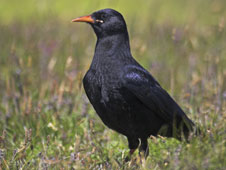
Chough (c) RSPB images

The Chough (pronounced 'chuff') is the rarest member of the crow family and is unique to the British Isles.

It is a particularly striking bird with black plumage typical of a crow and a bright red bill and legs.

Choughs have superb flying skills and often show them off is fantastic displays of swooping and diving.

In Scotland the Chough is confined to the west coast, particularly Islay, Jura, Kintyre, west Ayrshire and Islay where they can be seen feeding for invertebrates in fields. Due to the Gulf Stream, a milder climate on the west coast allows insects to remain active all year. The dung of grazing animals that are wintered outside provides an essential source of insects, especially for young birds. The strandline, where seaweed gathers, also provides a wealth of sand-hoppers, kelp flies and maggots in winter.

Due to a declining population of less than 500 in the UK, the Chough is on the amber list of birds of conservation conservation concern in the UK.

The Latin name, 'Pyrrhocorax Pyrrhocorax', derives from the greek meaning 'flame-coloured raven'.

Where to see them
Rocky coasts with short grassland. The RSPB has a reserve at Loch Gruinart, Islay where they can be seen all year round.

Page first published on Monday 7th April 2008
Page last updated on Friday 17th October 2008

Post Your Comment

Name:


Message:

FAST FACTS: CHOUGH

Latin Name: Pyrrhocorax pyrrhocorax
Gaelic Name: Cathag dhearg-chasach
Meaning: Red-legged crow
Statistics:
Body length 39-40cm
Wingspan 73-90cm
Weight 260-350g

Physical Description
Medium-sized, graceful crow with down-curved, red bill.

Scottish Distribution
Islay, Jura, Colonsay, Kintyre and west Ayrshire

Habitat
In the UK and Ireland they have adapted to wind-swept, coastal habitats.

Diet
The chough feeds almost entirely on the ground, primarily on insects and larvae, although in winter berries and grains are also important.

Young
The first eggs are laid in April; typically there is a clutch of 3-5 eggs in a bulky, untidy nest of twigs, roots, moss and plant stems on a cliff, in a cave or a building. The female has sole responsibility for incubation (around 17 days) while her mate feeds her at the nest. When the chicks hatch, the pair forage together, flying between the nest and feeding grounds every 30 minutes. After fledging, young birds join a non-breeding flock. Young birds learn the best spots where they can feed and roost throughout the year from their older roost mates. They stay in these flocks for at least two years before they pair up with a mate to breed. Once a pair has bred they generally stay together for life.

BBC © 2014The BBC is not responsible for the content of external sites. Read more.

This page is best viewed in an up-to-date web browser with style sheets (CSS) enabled. While you will be able to view the content of this page in your current browser, you will not be able to get the full visual experience. Please consider upgrading your browser software or enabling style sheets (CSS) if you are able to do so.