
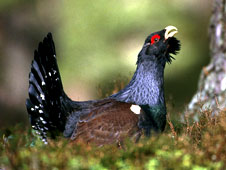
The capercaillie, the largest of the grouse family, became extinct in Scotland in 1785.
It was reintroduced during the nineteenth century but once again faces crisis; with the number of birds in steep decline, the capercaillie has been placed on the UK's red list of conservation concern.
The male capercaillie take part in a distinctive mating display every morning at dawn. He struts around at a lek (from the Norse word meaning 'to dance'), tail held vertical and fanned out, beak pointing skywards and wings drooping. A complex song of tapping, gurgling, and wheezing, ending in a drum roll, accompanies these extravagant displays. Part of the song is sub-sonic, below the range of human hearing but audible to distant birds. As hens come to the lek, displays intensify.
Hens lay in April and in their first couple of weeks the chicks are fed mainly insects, particularly moths, caterpillars and sawflies. The chicks are capable of flight after about 2-3 weeks when their diet becomes herbivorous, similar to that of their parents. After 2-3 months the chicks are fully grown.
In autumn, the brood may disperse, forming flocks. Females and offspring may remain together until spring, while young males tend to form mixed groups with other young females. Adult males tend to remain solitary.
In winter, birds move to pine woods and feed in tree crowns.
Where to see
Capercaillie are confined to native pinewoods in Scotland's north east and can be seen all year round. Occasionally they are seen from hides at RSPB Abernethy Forest, Loch Garten reserve.
Page first published on Monday 7th April 2008
Page last updated on Tuesday 8th April 2008


Post Your Comment