
Irvine Butterfield of The Mountaineering Council of Scotland on discovering the mountains of Scotland.
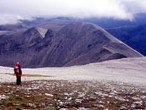
How often have you gazed upon a Scottish mountain scene and wondered what it would be like to reach the summit? Your first impressions will almost certainly be similar to those of earlier travellers whose initial explorations drew them towards the more accessible peaks which held promise of a extensive view.
Even today many of those venturing forth for the first time are persuaded to seek such a choice of belvedere in anticipation of surveying the countryside round about. In like fashion many have make their initial foray along a path leading to the summit of one of the more popular peaks such as Ben Lomond, Schiehallion, Ben Venue, Ben Ledi, or the smaller Beinn A’an in the Trossachs.
The opportunity of an ascent in good weather undoubtedly plays a part and these first tentative steps and the views of the day have proved so enchanting to many that they have sought to broaden their horizons in search of further adventure.
Which mountains?

Mountains like people come in many guises and Scotland possesses a veritable kaleidoscope of peaks. The Southern Highlands are probably the best known as sitting closer to the centres of population in the central belt these are most readily visited. Perthshire possesses a multitude of peaks ranged along the glens of the Tummel, Lyon and Tay. Those with a disposition to try their hand on the craggier peaks will find much to interest them in the peaks along the road to Fort William, around Glen Coe and Glen Etive.
Those seeking the remoter corners will be drawn northwards to the far north west corner of Sutherland. Here are found the scree spangled slopes of the Assynt and Reay Forest peaks, and the peaks fringing the remote sea lochs of Loch Eriboll and the Kyle of Tongue. Several of the peaks claim a western vista embracing the the long silhouetted chain of the Outer Hebrides and sometimes to the north the Orkney Islands can be seen.
Further south, Torridon sandstone has been eroded into impressive stacks and isolated peaks set in broad acres of lochan-jewelled moors of which the photogenic peaks of Stac Pollaidh and Suilven are the best known. The giants of the genre are to be found further south. Here stand tall the mighty An Teallach and the peaks of the Fisherfield Forest, which lies in the wild country between Little Loch Broom and Loch Maree in Wester Ross.
But it is in Glen Torridon itself that these majestic mountains assert a complete mastery of the scene - Liathach, Beinn Eighe and Beinn Alligin rise fully 3000ft and more from the level of the sea.
The summits
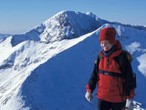
And what of the highest peaks of all? The popularity of Ben Nevis lies not only in it being the highest mountain in these islands but to those whose sport is found upon the crags and couloirs there is a litany of names which will become familiar to walkers and cragsman alike - Observatory Buttress, Tower Ridge, Gardyloo Gully to name but three.
The greatest concentration of ground above the 4000ft contour lies in the Cairngorms where, even in summer, conditions on the plateau can be arctic and the broad expansive heights gained by long walks along the rivers and streams which rise in deep secretive corries hidden in the heart of the mountains.
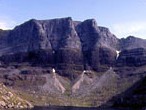
The islands too have their place in the pantheon of this mountain world. The distant archipelago of the Outer Hebrides has some of the oldest rocks in the world, their gnarled rugged heights looking west to the edge of the world itself where, on the distant horizon, sit the humps of St. Kilda.
The greatest accolades are, however, reserved for the rock ragged ridges of the Cuillin of Skye where newly-honed climbing skills will be tested on the rough gabbro before the chosen peaks are won.
A Munro addiction
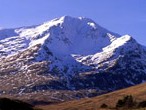
One does not have to be a mountaineer to have heard of the Munros. At 3000ft these are the highest of the Scottish peaks and their collective and eponymous name comes from Hugh T. Munro, later Sir Hugh T. Munro of Lindertis, near Kirriemuir. His list of 3000ft Scottish peaks was first published in the Scottish Mountaineering Club Journal of 1891.
Some ten years later, a fellow member of the club, Rev. A.E. Robertson, was the first to claim ascent of all the mountains. But it was to be some 70 years before the number of compleaters passed the century mark. Since then the interest and popularity of seeking to attain the Munro summits has accelerated to such a degree that the numbers now claiming compleation are fast approaching 4000.
If taking up the sport it is almost inevitable that you will ascend many of these higher Scottish Peaks. As confidence and interest grows you may be tempted to consider the attainment of all 284 Munros. Be warned, this can be addictive and if the bug really bites who knows you may even consider adding the 220 Corbetts (2500ft peaks), and 224 Grahams (2000ft peaks) to your tally.
Essential preparations

Initially, when taking these first exploratory steps into the hills on a summer’s day, it might be considered that the basics of a stout pair of boots, waterproof trousers and anorak will suffice. However, the vagaries of Scottish elements mean that the possibility of inclement weather at any time of year should be born in mind.
Start with something not too demanding and above all be conscious of your abilities and don’t rush - enjoy the day and look about you for there is much to see. The harsher rigours and challenges of winter mountaineering can come later.
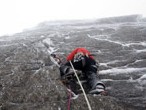
Nowadays you are spoilt for choice but it need not cost you the earth. New fabrics, and enhanced equipment design now afford a range of clothing and equipment suitable for all weathers. A good retail stockist should be able to provide you with something within your personal budget and assist you in your selection of suitable gear.
As a suggested minimum, prior consideration should be given to your choice of boots, waterproof anorak and trousers. In your rucksack you should carry a map and compass (and know how to use them), an emergency bivi-bag, a whistle, and torch (with spare battery).
It is also useful to carry a spare sweater, and extra food which may be in the form of chocolate, glucose sweets or similar confections.
Learn the ropes
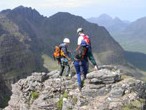
One of the best way of getting acquainted with the proper use of equipment and gear is to join a club. Diligent local enquiry should enable you to make contact, or failing that such information may usually be found by contacting the Mountaineering Council of Scotland.
Clubs affiliated to the Mountaineering Council are able to provide insurance cover at reasonable cost, and as an individual you will also have the benefit of access to further training in navigation and safety on courses run under the auspices of the Council. A quarterly magazine will keep you up to date on what is happening in the mountaineering scene be it climbing, hill-walking, mountaineering, access, or conservation.
As a basic handbook, you will also find much useful information about how to cope in the mountains in “Mountaincraft and Leadership” by Eric Langmuir, published by The Scottish Sports Council.
There are a great many other walking and mountaineering reference books available, including "The Mountain Skills Training Handbook" by Pete Hill, "Hill Walking: The Official Handbook of the Mountain Leader and Walking Group Leader Schemes" by Steve Long, and "Navigation for Walkers" by Julian Tippett. These are often available in local lending libraries, as are collections of Ordnance Survey maps.
The lure of the mountains
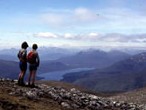
Whatever your chosen ambition, the ascent of Scotland’s mountains is at the very least an excellent way to encourage healthy exercise.
It is also one of the finest ways of seeing the country and the rewards to be gained from exploring many of its hidden corners in the company of like-minded souls are many.
And whatever the weather the experience will surely benefit you in both body and soul!
Page first published on Tuesday 23rd October 2007
Page last updated on Monday 18th August 2008

