
A sheep farmer at lambing time

Landward Executive Editor Lynne Mennie and her husband are sheep farmers in Aberdeenshire. Here she writes about some of the highs and lows of lambing season.
It doesn't matter how often you see it, the first breath of life is always a miracle. At lambing time we always have a regular stream of visitors to the farm, and while some use the excuse that the kids wants to see the baby lambs, there's no doubt the adults are just as thrilled if they arrive in time to see lambs being born.
We lamb mainly outside, and the first sign that a ewe is ready to lamb will often be when she wanders away from the flock to a quiet spot on her own, or she might start bleating quietly. What we want is for the birth to be as easy and natural as possible.

It normally takes between 10 and 30 minutes from the time the ewe first lies down to give birth until the moment when the lamb emerges into the world. You want to see two little hooves and a nose coming first, making a shape like a diver. If lambs are coming backwards, or a leg is twisted back, then it's almost certain that the farmer will have to help the ewe by giving the lamb a gentle pull.
The ewe licks her lambs clean, which helps stimulate their hearts and lungs in the first few minutes of life. The good mothers also talk to them with a low throaty chuckle which is unique to each sheep, and which they only use to their own babies. The lambs use this sound to find their mums when they are out in the field with all the other sheep.
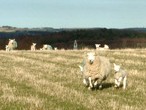
The newborn lambs are usually wobbling onto their feet within about 5 minutes, and they'll get their first drink of milk in about 15 minutes. This first feed is critical. The milk is thick and creamy, it has a very high fat content which helps keep the little lambs warm, and it contains a lot of antibodies to help keep any infections at bay.
All sheep farmers want two lambs per ewe if possible, but it's not unusual to have three or even four lambs. That's not so good, because ewes tend to find it hard to feed all those lambs, and keep such a big family together.

In just a few hours, the lambs will be confident on their feet, and will be able to run so fast that a human can't catch them. And when the spring sunshine is out, especially in the evenings, you'll see whole gangs of lambs running, jumping and skipping along the dykeside.
While filming newborn lambs under a heat lamp, Landward's camera crew discover a feline interloper. Published April 2008.
Comments Click here if you'd like to comment on these videos
Page first published on Thursday 27th March 2008
Page last updated on Thursday 27th March 2008


Post Your Comment