

James Westland answered our call for summer adventure stories. Here he reveals details of a journey to Scotland's west coast.
During World War 2, mica was in short supply. India had been the main supplier but an alternative source was needed. Several localities in the Highlands were identified, but the most productive was also in the most remote area imaginable - on a hillside above Loch Nevis in Knoydart.
The plan for this trip was to visit the old workings and collect some specimens if possible. I am a geologist by training, having studied at St Andrews in the late 70s. I have been intrigued by this location for quite some time and have been meaning to visit it - a fine spell of weather in May 2008 seemed to present me with an ideal opportunity. And I didn't expect the midges to be too bad either!
Click here to see the location in Knoydart.
The adventure, day one
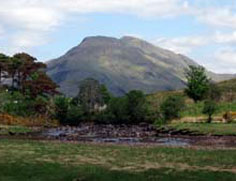
There are only two ways into Knoydart - on foot from either Kinlochhourn or Loch Arkaig or by boat from Mallaig. The boat is definitely the easier option! I managed to get a lift over with one of the private operators who had arranged to take over a large party who were on holiday. I arrived in Inverie about 1:30 pm.
I had arranged to stay at the Knoydart Foundation Bunkhouse, located at the east end of the village. The warden of the Bunkhouse, Isabel, made me very welcome - this was the first time I had stayed in it - I thoroughly recommend it. After a quick bite of lunch it was time to start exploring.
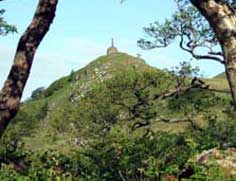
I spent Saturday afternoon exploring Gleann Meadail. The path that runs up this glen leads eventually to the head of Loch Nevis where there is an excellent bothy called Sourlies. Form Sourlies there is a famous pass called the Mam na Cloich Airde which takes one through to Loch Arkaig where the public road ends. I have fond memories of the Mam na Cloiche Airde - one of the most dramatic hill passes in Scotland.
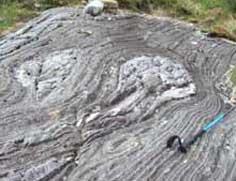
I followed the path up Gleann Meadail taking in the geology en route. Most of the rocks in the area are Moine Schists and some of them have been folded into the most remarkable patterns. The effect has also been enhanced by ice-smoothing and polishing during the last ice age. The pictures show the effect. After taking several pictures and working out my route for the next day, I returned to the bunkhouse by the same well trodden path.
Day two
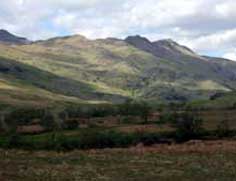
I awoke to more blazing sunshine (and hungry midges). The weather forecast was holding up well! As I headed up Gleann Meadail, the mica schist pebbles on the path glistened in the sun - a hint of things to come maybe?
There doesn't really appear to be an easy way to the mica mines. They lie high up on a ridge running off the peak of Sgurr Coire nan Gobhar at an altitude of about 1800 ft. There isn't really a path as such, so it was a case of picking the line of least resistance up the hill and round to where the mines are located. The distance is not actually that great - only a couple of miles, but there is affair amount of rough walking involved. It is typical Knoydart type territory - rocky, craggy, steep - a scene enhanced by the backdrop of the sea and the islands in the distance. First class hillwalking which would only have been enhanced by the presence of snow on the peaks (although a blanket of snow may have made the hunt for the mines rather more challenging!)
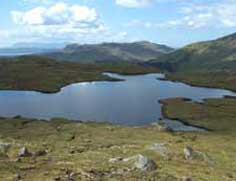
I arrived in the area of the mines about noon. They lie above a small lochan on a spur running from a subsidiary peak called Tom an Neoil, the “hill of the cloud”. To the south lies Loch Nevis, one of the most fjord like of the Scottish sea lochs, and the perfect backdrop.
The mines are not really mines in the strict sense - they are more like small quarries. There are huge amounts of mica lying around and I collected several samples. The mica is found in a rock called pegmatite which is like a super coarse granite.
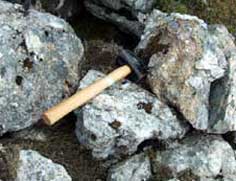
Also found in the pegmatite is the mineral beryl. I managed to find 4 pieces of this, its distinctive green colour standing out against the pink of the feldspar, the silver of the mica and the white of the quartz. The pictures show the samples - I have included my hammer for reference, but many of the mica pieces are up to 6 inches in size.
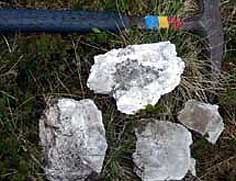
One of the mines has a building nearby in a ruinous state. Inside the building lie the remains of what looks like some sort of compressor, made by the delightfully named “Lead Wool Co Ltd, Snodland, England”. At one of the other mines I found an old barrow, rusting away in its final resting place, its labours over, slowly disintegrating in one of the remotest industrial sites in the UK.
I took some more pictures then headed back down the way I came. Much easier on the descent, even with a rucsac full of rocks and hammers!
Day three
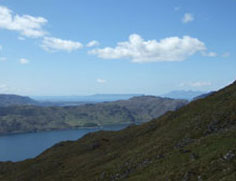
As I was getting the boat back to Mallaig at 11:00 am, there wasn't a lot of time to go for a long walk but it was nice just to have a stroll about and plan some walks for a future date.
After lunch in Mallaig, I headed off to Loch Morar and the path that runs over to Stoul on the shore of Loch Nevis. I wanted to see and to get a picture of the hill where the mica mines are from the other side of the loch. And also to get a view of the stunning peak, Sgurr na Ciche at the head of Loch Nevis, surely one of Scotland's most spectacular hills, rising like a mini Matterhorn at the head of the loch.
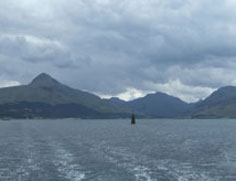
Unfortunately, the weather wasn't quite so bright and the lighting was very “flat”. The pictures however give a feel for the area which has a great fell of remoteness about it. And after spending some time by the shore of Loch Nevis, it was back to the car and off home again!
So that was that, my visit to the mica mines. There is always a danger when you read about a place like this that an expectation can be built up and that the actual visit can be an anti-climax. I can honestly say that this was not the case. The weather played its part, no doubt but the combination of scenery, location and the sheer sense of wilderness made for a memorable trip, my first to Knoydart for a very long time.
Thanks to everyone I met there, especially Isabel at the bunkhouse who was very helpful and friendly - hope you enjoy the mica sample!
If you'd like to tell us about your own adventure plans email us with details.
Page first published on Thursday 15th May 2008
Page last updated on Thursday 16th October 2008


Post Your Comment