<< Page 1, Page2 >>
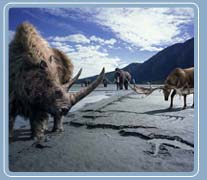
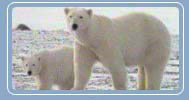
From dinosaurs on Skye and the world's oldest reptile in Bathgate, to giant tropical forests in Glasgow, many of the secrets of our ancient residents have been mined from the earth. Fossils show the wealth of exotic beasts that have lived here: from woolly rhinoceros in Bishopbriggs and giant elk grazing by the Solway, to polar bears hunting seals on ice flows near Inchnadamph. Many of these prehistoric victims of ecological circumstance are now extinct, evolutionary dead ends, known to us only by their bones.
Then, 10,000 years ago, a terrible new challenge to Scotland's flora and fauna emerged from a species called Homo sapiens. In a mere eye-blink of evolutionary time, we humans have had a catastrophic effect. With our agriculture and hunting, we have plundered and altered the land for food and sport, directly causing the extinction of a great number of species. Many more are endangered or no longer remain in Scotland.
A combination of habitat loss and persecution saw the disappearance of wolf and brown bear, beaver, lynx, wild pig and moose, cappercaillie and auroch. With the rise of the country estate in the 19th century, many of the remaining predators were perceived as a threat to sport - polecat, sea eagle, red kite, goshawk and osprey all went this way. Whaling also took its toll: the right whale was lost in 1928, and the last of our blue whales was seen in 1953. Though not so visible, the passing of many less dramatic species - lichen, or obscure beetles - is perhaps no less significant. The long-term effects of such ever-decreasing diversity are hard to predict. It's not all bad news, however - conservation has made great progress in managing rare wildlife. Sea eagles and red kites now grace Scottish skies again. Yet despite our best efforts, many plants and animals are still living life on the edge, and their futures remain uncertain. The Aliens Have Landed
If they do manage to survive the meddling of man, native species have another sinister threat to contend with - aliens. Alien species are those which have evolved elsewhere, becoming resident in Scotland through migration, and they pose the greatest threat to biodiversity after habitat loss. The routes by which they arrive are as various as the species themselves. There are now at least 1000 alien species in Scotland.
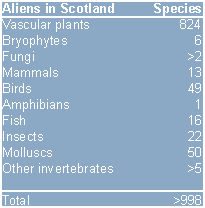 Some aliens were carried as ancient cargo, like the Orkney vole, brought by settlers over 5000 years ago; or the rabbit, introduced from France by the Normans. Many of our exotic plants and animals were brought from overseas, as curiosities. More recently, bulk transport of grain, fruit and ballast water have introduced many new species. Usually, they remain confined to small areas, exerting little impact. Some aliens were carried as ancient cargo, like the Orkney vole, brought by settlers over 5000 years ago; or the rabbit, introduced from France by the Normans. Many of our exotic plants and animals were brought from overseas, as curiosities. More recently, bulk transport of grain, fruit and ballast water have introduced many new species. Usually, they remain confined to small areas, exerting little impact.
Sometimes, however, an accident of evolution means that an alien turns out to be better adapted to life in Scotland than the natives. On the next page is a list of well-established aliens which have had a huge effect on Scottish wildlife, and whose success in their new home may pose a threat to many of our indigenous species.
<< Page 1, Page2 >> |