 | << Page 1, Page2 >>
26th June 2002
For the Highlands film, we wanted to show how tough the mountain-nesting birds are. Snow buntings are little birds, which wouldn't look out of place next to the chaffinches on a bird table. But as we found out, even in the week of the summer solstice, their home can be perishingly cold.
After a mere eighteen sub-zero hours scrambling over the boulder scree in a Cairngorm corrie, we came home with a new appreciation for these ice-age survivors, and the hardest won shot of the series - a solitary snow bunting which sang once and flew away. Total duration: eight seconds. 2nd July 2002
You can't beat a bit of luck. Killer whales or orcas sometimes visit Shetland - but we knew our chances of catching one on camera were slim. Ellen, the researcher for this programme, had managed to get herself included on a list of phone numbers which would be called if any whales did show up. We didn't expect to hear anything more. The phone rang just before the plane arrived, bringing Julie, Paul the producer and the soundman Ken to Sumburgh airport. A pod of orcas had just been seen heading south along Shetland's east shore. We took advice and headed for Moussa Sound, where a pod had paused last year. As the same whales visit year after year, we hoped we might be lucky.
Almost as soon as we arrived there, we spotted the pod. The male's dorsal fin was so huge it marked his position like a black flag. Our luck hadn't run out yet - the ferry man strolled down and offered to take us out to see the whales, so we had one of my best ever wildlife moments. With the engine off, gently rocking in Moussa sound, we were surrounded by a pod of orcas while they herded a shoal of fish, surfacing to breathe right by the boat. Fantastic. 28th July 2002
There is an animal in Scotland which grows to six or seven centimeters, and can live more than a hundred years. It's rarely seen and has almost never been filmed. It is in serious decline, and is certainly the most endangered animal we filmed, so much so that I'm not going to say where we filmed them. It is the freshwater mussel. After some hours spent up to my waist in a river while enjoying their company, I can't say that they do a great deal, except filter the passing current. However, knowing that these rare mussels might be there has made me look at rivers in a new light. Some west coast rivers have their entire flow of water filtered through freshwater mussels on its way to the sea. 23rd September 2002
I had never seen a pine marten until today, so I was delighted when three of them arrived at once, scrabbling around the cottage we were staying in. They didn't come until it was dark, but they weren't bothered by our presence, even though we'd removed a windowpane to get a clearer view. The moment of truth came when one especially large marten jumped up onto the sill below the missing window and paced back and forth, chuntering away to himself. I could have reached out and touched his sleek, brown back, but he seemed oblivious to the space where the glass usually is. I can see him now, gliding to and fro in front of me - a bright, lithe encapsulation of wildness, with enormous feet. 3rd October 2002
"Okay, you have a couple of days to film golden eagles," they said. "Good luck!" I know cameramen who have spent three days and nights at a time in hides, waiting for golden eagles to accept them. Eagles have such fantastic vision, and they are notoriously wary, so I was not entirely sure I would succeed in capturing them on camera. After many fruitless hours on Rhum, with only a few very distant shots of a pair of birds soaring, it seemed like time for plan B. The best thing in such situations is usually to look for something entirely different to film, so we went off in search of some deer. Sure enough, round the corner of the glen came three golden eagles.
The magnificent birds did not seem to pay any attention to us; they had more pressing matters in hand. Two adult eagles were driving the third bird out of their territory. They did this in the most dramatic way imaginable, diving at the young bird and trying to rake its back with their talons, so the bird had no choice but to roll upside down, presenting its own talons. Twice the birds locked claws and tumbled together. The eagles' control was breathtaking; sometimes the adults stalled and missed the youngster by less then a wing's length. The young bird fled, hugging the ground. We stood amazed, and watched all three of them until they were specks in the distance. 25th October2002
The last day of filming. It's the season for grey seals to pup, and we've chosen to film them on the Isle of May in the Firth of Forth. The island is home to some extraordinary seals, which have taken to using mobile phones. The phones are actually glued to their heads by researchers from St Andrews, and will report on their seals' wellbeing and their whereabouts by sending text messages back to base. The researchers' main worry is that, if the seals swim as far as Norway, the call charges will be a bit steep, their phones will be filled up with junk emails and the batteries will run out. Who said technology makes life simpler?
Looking across this wind-swept island towards Edinburgh, and thinking back to the first day in the Necropolis, there's no doubt which is the wilder place. In some ways, though, filming this series has shown me that these, and the other places we've filmed, aren't so different to each other. A lot of wildlife in Scotland is within reach of where most of us live. Perhaps these programmes will encourage more people to go and have a look for themselves. << Page 1, Page2 >>
|  | | 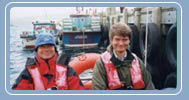 | | | | | Leaving for Shiants, there's time for a quick snap-happy moment. | | 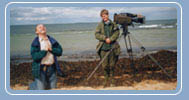 | | | | | Divine Intervention? When luck runs out, more radical steps are called for... | 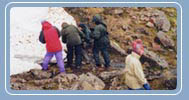 | | | | | From summer to winter, our resilient crew weather the weather. |
|








