
Shooting Nazis
A notorious ancestor leads to a family history quest.
 |  |
"Most families have some dark secret, this is ours; my grandfather shot Rudolf Hess. In 1933 he shot the Prince of Wales while he was playing golf at Gleneagles. He tried several times to shoot Queen Mary, but she was having none of it."
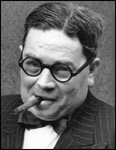
Curiosity about the life, work and notoriety of his grandfather has led Nick Rowswell on a quest to uncover his Scottish roots. Rowswell's investigations uncovered the dynamic character of George Alexander Simpson, photographic pioneer and one of the earliest paparazzi. Grandpa George got the scoop of his career when he secured the first pictures of the top Nazi on his ill-fated peace mission in 1941.
The flight of Rudolf Hess at the height of the Second World War was one of the oddest diplomatic missions in history and has become a favoured topic of conspiracy theorists. It is believed that when Hess set off across the North Sea towards Scotland on the 10th May 1941, he was heading for Dungavel, the seat of the 14th Duke of Hamilton. Forced to bale out from the unfortunate plane 6,000 feet above Renfrewshire, Hess landed in a field at Eaglesham, his aspirations of brokering a peace with Britain vanishing with the crash of his Messerschmitt. Hess had met the Duke, a fellow keen aviator, at the 1936 Berlin Olympics.
If he hadn't broken his ankle on crash landing, Hess might have managed to get to Dungavel. It is believed that Hess wished to convince the British government, in the midst of the heavy assault of the Blitz, that the Nazis did not wish to destroy Britain, but gain "lebensraum", or living space, for the German nation. However, Grandpa George, a one-legged former railway clerk from Bo'ness, was about to intervene and assist with the propaganda coup of capturing Hess - on film.
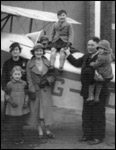
Born in the county of Linlithgow and disabled in an accident at Bo'ness railway station as a youngster, George Simpson's burgeoning photographic career was boosted when he was the first photographer to get pictures of the German Fleet scuttled in Scapa Flow in 1919. In the early '20s, Simpson moved from the Daily Record to become chief photographer at the Daily Mail. "Grandpa George was a 'paparazzo' long before the word had been invented. He thought nothing of climbing trees, scaling walls or hiding in bushes when it came to an exclusive". Simpson was also a pioneer of aerial photography in Scotland, and was twice a passenger in planes that crash landed, once in the North Sea. A similar emergency landing inextricably linked the adventurous snapper with the Nazi leader. By May 1941, France, the Low Countries and Norway had already fallen to the Germans, leaving Britain isolated and exposed to sustained bombings by the Luftwaffe. Glasgow and Clydebank were attacked night after night in bombing raids at this dark time. Hess was taken in by a local farmer in Eaglesham, having abandoned his plane and broken his ankle.
 |
Instead of informing the Duke of Hamilton, the farmer chose to alert his photographer contact, George Simpson, who navigated his way through blacked-out Glasgow to Eaglesham, where "after a few questions to confirm the deputy Fuhrer's identity, my grandfather finished his tea and shot him." The following day, Simpson's world exclusive hit the front page of the Daily Mail. His photographic coup triggered a propaganda war between Churchill, who suggested dissent among leading Nazis, and Hitler, who decreed that Hess was insane and had been suffering from "hallucinations".
Hess spent the rest of the war as a POW; he was tried at Nuremburg and spent the rest of his life at Spandau prison in Berlin. Simpson eventually retired from journalism in 1960. Following the theft of the Stone of Destiny, George Simpson was one of the first on the scene when the stone was discovered at Forfar in 1951.
His grandson Nick Rowswell, now resident in France, continues to look for further details from his Grandpa George's life. His quest began when seeking the infamous photograph of Hess. "Originally, I just wanted to find the photo of Hess, but now I'd like to write down my family history, if only for my daughter. My father died when I was 6, and I know very little about his family. If ever anything happens to me, I'd like my daughter to know something about her ancestors".
Listen to Nick talking about his grandfather on Home Truths, BBC Radio 4, on September 6th 2003. Click on the "Grandad who shot Hess" link on the Home Truths page.
Memories of Hess's flight in wartime are recalled in Scotland on Film. Click on the Scotland's Home Service: Rudolf Hess link on the page.
Find out more about Hess's role in the Second World War on BBC History.
Next in the Histories series here.
| |









