Sex IDThe link between sex drive and sexuality Gender researcher Richard A Lippa summarises his analysis of data from the BBC web experiment Sex ID, for which he was a scientific consultant. Lippa's findings were published in the April 2007 issue of the Archives of Sexual Behavior.
 We showed that the higher women's sex drives, the more they desire both sexes. Conversely, the higher men's sex drive, the more they desire either one sex or the other, depending on their sexual orientation. For most men, a higher sex drive simply intensifies their existing sexual orientation. We showed that the higher women's sex drives, the more they desire both sexes. Conversely, the higher men's sex drive, the more they desire either one sex or the other, depending on their sexual orientation. For most men, a higher sex drive simply intensifies their existing sexual orientation.
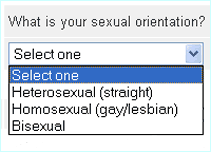
The common sense view is that heterosexual men with high sex drives are very interested in women, and gay men with high sex drives are very interested in men, and this is indeed what the BBC data showed. The unexpected result was that women seem to be more intrinsically bisexual in their sexual attractions. Whereas men tended to be either/or (heterosexual or gay), women had more shades of grey. The data from the BBC survey suggest that the differences between women and men may have biological causes, because the results were very consistent across a number of countries, including the United States, the United Kingdom, Canada, Australia, New Zealand, Ireland, India, Malaysia, and Japan. Results were also consistent across a number of world regions, including Western Europe, Eastern Europe, and Latin America, and they were equally true for people over 30 and under 30 years of age. My analyses of the data show that most women were considerably more attracted to men than to women, and thus it is incorrect to label most women as 'bisexual'. However, many more women than men expressed some degree of attraction to their own sex. In the BBC survey data, 90% of women labelled themselves as heterosexual, 7% as bisexual, and 3% as lesbian. In contrast, 91% of men labelled themselves as heterosexual, 4% as bisexual, and 5% as gay. Nearly twice as many women as men identified themselves as bisexual, but almost twice as many men as women labelled themselves as homosexual.
Lesbians were the only group of women who did not show the 'high sex drive leads to increased attraction to both sexes' effect. Instead, they showed the pattern typical of heterosexual men – for lesbian women, high sex drive was associated with increased attraction to women, but not to men. Why lesbians differed from other women is not clear. I speculate that the difference may result from the effects of hormones present in the womb (prenatal hormones), particularly androgens, which include male hormones such as testosterone. Some social scientists argue that sexual orientation is influenced by prenatal variations in sex hormones like testosterone. Lippa is Professor of Psychology at California State University, Fullerton. Further information about his research and his analysis of the BBC data can be found at: http://psych.fullerton.edu/rlippa/index.html.  Read more aricles about the Sex ID results Read more aricles about the Sex ID results
Take the Sex ID test Read about the Sex ID experiment Sex ID frequently asked questions
|