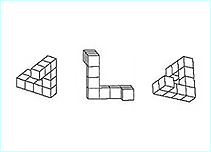
Sex IDSexual orientation predicts mental rotation ability People's ability to rotate objects in their minds (spatial processing) is affected by their sexual orientation, according to new research by Professor Michael Peters, Dr Stian Reimers and Professor John Manning. Here Stian Reimers summarises their analysis of data from the BBC web experiment Sex ID, for which he was a scientific consultant. The findings were published in the April 2007 issue of the Archives of Sexual Behavior.  We asked participants to give their sex and orientation, and complete a challenging task in which they had to recognise rotated versions of a 3D block shape. We asked participants to give their sex and orientation, and complete a challenging task in which they had to recognise rotated versions of a 3D block shape.
Some of our major findings: On average, men were better at the task than women were. Gay and bisexual men were significantly worse at the task than straight men were. Lesbian and bisexual women were significantly better at the task than straight women were. "These effects are significant when you look across thousands of men and women, but not at an individual level. Lots of factors affect how well people score, so you can’t guess how well one person would do by their gender or sexual orientation," my colleague Michael Peters says. Comparing the length of people's index finger with their ring finger also predicted their score: The shorter the index finger relative to the ring finger, the better people did, on average. According to my colleague, John Manning, "Digit ratio appears to tell us how much testosterone people were exposed as they were developing in the womb. So it seems that prenatal testosterone levels may affect spatial ability in later life." Women who took the combined contraceptive pill scored significantly higher than women who didn't, even when other factors like age and education were taken into account. "We are not the first to discover that taking the pill improves spatial ability, but although the difference is very small, with a sample this size the effect is very clear," Peters says. "It suggests that hormones play a part in performance, but exactly what they do is not yet clear."

Stian Reimers was lead scientific advisor on the Sex ID project. He is a psychology researcher at University College London. Michael Peters is Professor of Psychology at the University of Guelph, Ontario, Canada. John Manning is Professor of Psychology at the University of Central Lancashire.  Read more aricles about the Sex ID results Read more aricles about the Sex ID results
Take the Sex ID test Read about the Sex ID experiment Sex ID frequently asked questions
|