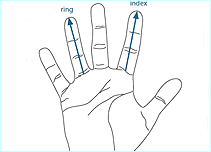
Sex IDFinger length ratios predict sex and sexual orientation Dr Stian Reimers summarises Professor John Manning, Dr Andrew Churchill and Professor Michael Peters's analysis of data from the BBC web experiment, Sex ID, for which they were all scientific consultants. Their findings were published in the April 2007 issue of the Archives of Sexual Behavior.  My colleague's research suggests that the relative length of a person's fingers is associated with their sex and their sexual orientation. They got participants to measure the length of their index and ring fingers and computed the ratio between the length of their index fingers and ring fingers – their second to fourth digit ratio, or '2D:4D ratio'. The 2D:4D ratio is thought to be affected by the amount of testosterone a person is exposed to in the womb. My colleague's research suggests that the relative length of a person's fingers is associated with their sex and their sexual orientation. They got participants to measure the length of their index and ring fingers and computed the ratio between the length of their index fingers and ring fingers – their second to fourth digit ratio, or '2D:4D ratio'. The 2D:4D ratio is thought to be affected by the amount of testosterone a person is exposed to in the womb.
Some of the major findings: Men, on average, had a smaller 2D:4D ratio than women, reflecting the fact that male foetuses are exposed to more testosterone in the womb than female foetuses are. Gay white men had larger 2D:4D ratios than straight white men, suggesting that sexual orientation may be influenced by prenatal testosterone levels. "We can be pretty sure from a large number of human and animal studies that digit ratios are affected by prenatal testosterone exposure. So this result suggests a link between the hormones a baby is exposed to in the womb and their sexual orientation in adulthood," Manning says. "There has been a lot of discussion about whether digit ratios and sexual orientation are connected. It has taken a survey this size to investigate the issue fully, partly because the effect is so small – you need to average over a lot of people to see it." There was no significant difference in digit ratio between lesbians and straight women. "There was a trend for lesbians to have lower digit ratios, suggesting more testosterone exposure, but this was not statistically significant. This mean's the jury's still out," Mannings says. - Ethnicity also affected the results. Differences in 2D:4D ratio between gay and straight men were strongest in whites, and there was no evidence of such a difference among black or Chinese participants.

Stian Reimers was lead scientific advisor on the Sex ID project. He is a psychology researcher at University College London. John Manning is Professor of Psychology at the University of Central Lancashire, and specialises in digit ratios and associated performance. Andrew Churchill is a senior lecturer, also at the University of Central Lancashire. Michael Peters is Professor of Psychology at the University of Guelph, Ontario, Canada.  Read more aricles about the Sex ID results Read more aricles about the Sex ID results
Take the Sex ID test Read about the Sex ID experiment Sex ID frequently asked questions
|