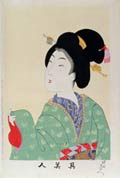
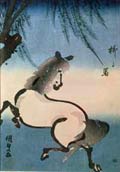
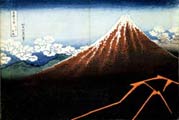
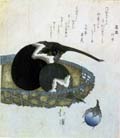
Japanese ukiyo-e ('pictures of the floating world') are woodblock prints that usually show scenes from everyday life. They are prized around the world for their simplicity and elegance. At the height of ukiyo-e production in the late 1700s, erotic images of women and depictions of actors were popular. Artists began printing landscapes and other natural subjects when the government increased censorship and tastes changed. In the mid-1800s, many Japanese artists began incorporating Western painting techniques in their work. Western artists, including the Impressionists, were inspired by the Japanese use of colour in landscapes and other natural scenes. A 17th century Japanese author, Asai Ryoi, captured the spirit of ukiyo-e when he wrote: "Living only for the moment, turning our full attention to the pleasures of the moon, sun, the cherry blossoms and the maple leaves... this is what we call the floating world (ukiyo-e)." If you like Japanese art, you might also like: - Art Nouveau – A decorative style with twisting lines inspired by plants. The painter Henri de Toulouse-Lautrec collected Japanese art, which influenced his paintings.
Artists: Alphonse Mucha, Gustav Klimt and Aubrey Beardsley
- Impressionism – The Impressionists were inspired by Japanese art. They tried to capture temporary lighting effects found in nature with bold daubs of colour.
Artists: Claude Monet, Paul Cézanne and Edgar Degas
- Manga comics – Wildly popular around the world, these Japanese comics are descendants of ukiyo-e woodblock prints.
Artists: Akira Toriyama, Hiromu Arakawa and Eiichiro Oda
Return to art styles homepage |