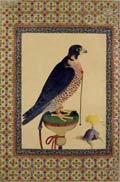
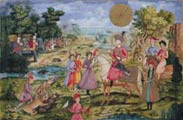
Unlike western art, Islamic art is difficult to separate into different styles. That's because, for the most part, artists in countries influenced by Islam continued to follow traditional methods. Western artists, on the other hand, have periodically rebelled against tradition and created radically new styles – abstract art, for example. That's not to say Islamic art isn't innovative. Artist's tended to put their new ideas in the detail, which isn't always noticeable at first. Islamic art often includes elaborate calligraphy of Koranic verses, vibrant colours and geometric patterns. Religious Islamic art doesn't include human images because portraiture is considered to be idolatry in Islam. But in non-religious, private paintings from societies influenced by Islam, human figures are extremely important. The Islamic era begins when the prophet Muhammad migrated to Medina in AD 622. If you like Islamic art, you might also like: - Byzantine art – Byzantine art is early Christian art created in the Eastern Roman empire, which later came under Islamic influence.
- Traditional Indian art – Many religions (including Islam) are reflected in the art of the subcontinent. Indian art often includes calligraphy and patterned designs.
Artists: Abu'l-Hasan, Bichitr and Govardhan
- Fauvism – Henri Matisse founded this short-lived artistic movement. He was influenced by Islamic art and incorporated patterned designs in his paintings.
Other artists: André Derain and Maurice de Vlaminck
Return to art styles homepage |